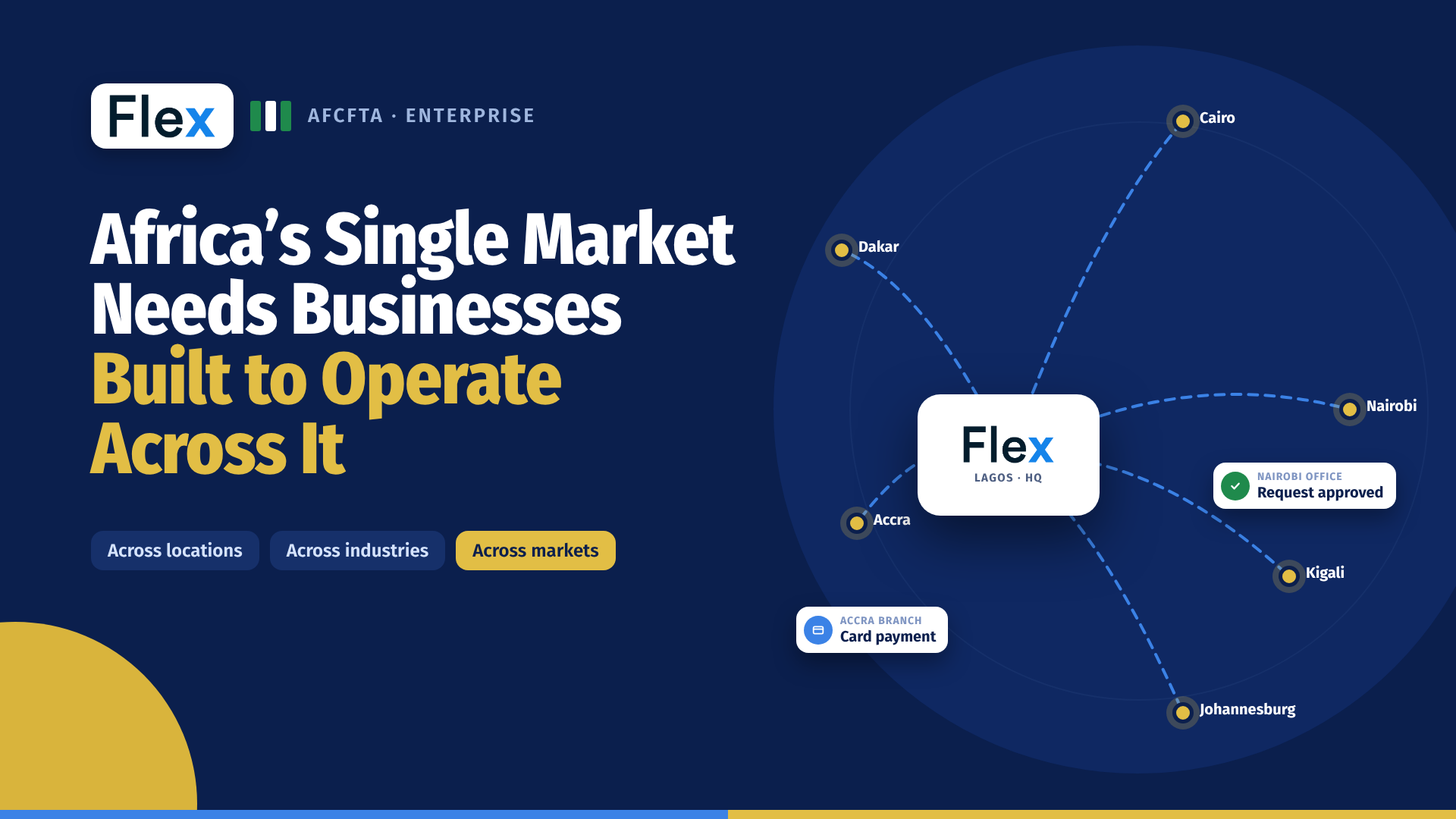
As Nigeria advances the ambitions of the African Continental Free Trade Area, the next chapter of continental integration is taking shape within African enterprises. Flex Finance is contributing to that transformation through intuitive spend management software designed to support businesses as they grow across locations, industries and national markets.
In January 2025, a shipment of synthetic filaments manufactured in Nigeria arrived at the Port of Mombasa in Kenya.
Produced by Lucky Fibres Limited, a subsidiary of the Tolaram Group, the consignment marked an important milestone in Nigeria's participation in the African Continental Free Trade Area (AfCFTA). It was the country's first shipment to Kenya under the agreement's preferential trading arrangements.
The journey from Nigeria to East Africa represented more than the movement of manufactured goods.
It illustrated the commercial possibilities of an African economy becoming increasingly connected through production, trade and investment.
Across the continent, a broader transformation is gathering momentum.
African enterprises are extending their operations beyond their domestic markets. Manufacturers are developing regional supply chains. Distribution companies are reaching customers in neighbouring economies. Industrial groups are investing in production facilities and commercial infrastructure across multiple countries.
The Dangote Group offers a compelling illustration of the scale of this opportunity. Dangote Cement operates across 11 African countries, with an industrial and distribution network extending through West, Central, East and Southern Africa.
These developments point towards an increasingly important reality: Africa's economic integration will be realised through enterprises capable of producing, distributing and competing across national markets.
The African Continental Free Trade Area provides a framework for that transformation.
With 54 countries having signed the agreement and 50 having ratified it by October 2025, AfCFTA represents one of the world's most ambitious efforts to establish a continental market for goods and services.
Its economic promise is substantial.
According to Afreximbank's African Trade Report 2025, trade between African countries grew by 12.4% to approximately $220.3 billion in 2024.
The World Bank has estimated that deeper implementation of AfCFTA, accompanied by wider investment and trade reforms, could increase regional incomes by as much as 9% by 2035 compared with a baseline without the agreement.
But the significance of a single market extends beyond the volume of goods exchanged.
A larger market creates the opportunity for larger businesses. Realising that opportunity requires companies with the operational and financial systems to function at continental scale.
That is where enterprise technology, and particularly business spend management, becomes an important part of Africa's trade story.
Nigeria's role in building a continental market
Nigeria occupies a distinctive position in Africa's economic integration.
As the continent's largest national market by population, it combines substantial consumer demand with productive capabilities spanning manufacturing, agriculture, energy, logistics, trade and technology.
Its domestic market has provided a foundation for enterprises that increasingly view Africa as a natural extension of their commercial ambitions.
Nigeria's engagement with AfCFTA reflects this opportunity.
In 2019, the country established the National Action Committee on AfCFTA to coordinate public and private sector participation in implementing the agreement.
Its mandate included preparing Nigerian businesses to participate in continental markets, strengthening production and service capabilities, improving competitiveness and supporting the development of regional value chains.
These priorities recognise an important economic principle.
Trade integration creates greater value when businesses have the productive capacity and institutional capabilities to participate effectively.
Nigeria has continued to advance this agenda through its AfCFTA Coordination Office, working with trade institutions, industry groups, regulatory agencies and the private sector.
In July 2026, the country assumed the chairpersonship of the AfCFTA Council of Ministers responsible for trade.
The transition came as the Council placed renewed emphasis on translating the agreement's institutional framework into commercial outcomes.
For Nigerian businesses, this represents a significant opportunity.
Manufacturers can pursue larger regional markets. Agricultural processors can develop relationships with buyers across the continent. Logistics operators can support expanding trade corridors. Technology companies can serve businesses operating in multiple African economies.
The benefits extend beyond individual transactions.
A more integrated continental market offers opportunities to develop specialised industries, deepen supply chains and create companies capable of competing at international scale.
The next phase of that development will depend substantially on the quality of the enterprises participating in it.
The financial implications of becoming a pan-African business
Expansion into another market is often discussed in terms of commercial opportunity: new customers, greater demand, additional distribution channels and increased production.
Within the enterprise, it also represents an evolution in financial management.
Consider a Nigerian manufacturing company establishing distribution operations in Ghana while supplying customers in Kenya.
Its headquarters may continue to oversee group financial strategy, while regional managers coordinate their respective operating activities.
Procurement teams purchase supplies. Warehouse supervisors manage maintenance and operating expenses. Logistics departments coordinate local transport providers. Finance teams maintain budgets and financial records across business units.
The organisation becomes more geographically distributed.
Yet management still requires a coherent understanding of how resources are allocated and spent.
A business operating across several countries must combine central financial oversight with the practical independence required by local teams.
Responsibilities need to be clearly established. Budgets must reflect the activities of different departments and locations. Expenditure should follow appropriate authorisation procedures, while financial records provide management with a reliable view of operations.
These are familiar principles of enterprise financial management.
Their importance becomes greater as companies expand.
The defining capability of a pan-African enterprise is not simply its presence in several countries, but its ability to operate across them as a coherent organisation.
Financial systems play an essential role in making that possible.
They allow businesses to preserve common standards of financial responsibility while accommodating the operating requirements of different markets.
For companies developing regional ambitions, this represents an important aspect of institutional maturity.
Beyond payments: the financial operating systems of continental trade
Africa's financial institutions are advancing the infrastructure required to support deeper economic integration.
Nigeria has already established one of the continent's most sophisticated real-time payment ecosystems.
At the regional level, the Pan-African Payment and Settlement System (PAPSS), developed by Afreximbank in partnership with the African Union and AfCFTA Secretariat, is helping create new possibilities for payments between African countries using local currencies.
In May 2025, Afreximbank welcomed changes to the Central Bank of Nigeria's PAPSS documentation requirements, designed to make participation more accessible to businesses engaged in intra-African trade.
In October 2026, Ethiopia's central bank joined PAPSS, marking another step in the development of a more connected continental payments network.
These advances are significant for African commerce.
They expand the financial infrastructure available to businesses participating in regional markets.
There is, however, another layer of financial activity within an enterprise that operates alongside banking and payment systems.
Before money moves, a business decision must be made.
A supplier needs to be engaged. A department requires an operating budget. An employee requests funds. A manager evaluates the expenditure. A finance officer authorises or completes the payment.
The transaction must subsequently be documented and reflected in the organisation's financial records.
This sequence is the foundation of business spend management.
Banking infrastructure facilitates the movement of money. Accounting systems maintain financial records. Enterprise resource planning platforms coordinate broader commercial and operational functions.
Spend management connects the financial decisions, responsibilities and workflows through which money is used throughout the organisation.
The distinction matters because financial transactions do not exist independently of business operations.
Every payment has a commercial purpose. Every budget represents an allocation of resources. Every approval reflects a decision about how the enterprise should deploy its capital.
Connecting these activities creates greater continuity between management decisions and financial outcomes.
For regional businesses operating across multiple locations, departments and subsidiaries, that continuity becomes increasingly valuable.
It enables local operations to function within established financial policies while providing central management with visibility over expenditure.
In an increasingly integrated African economy, these capabilities form part of the enterprise infrastructure supporting commercial expansion.
Flex Finance and the evolution of African enterprise spending
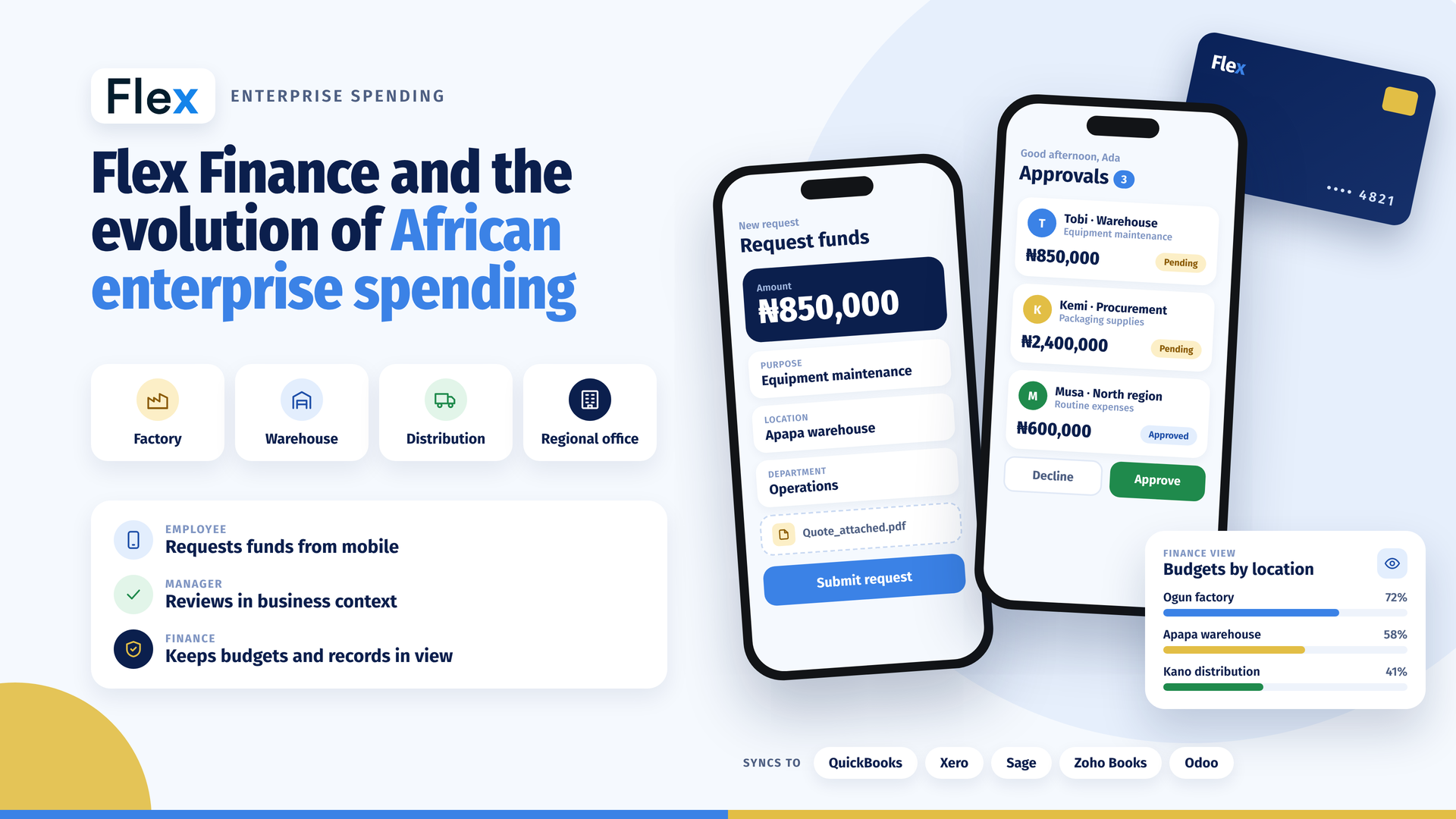
Flex Finance has established its business around the financial activities that connect an organisation's operating decisions to its expenditure.
Its spend management platform brings together expense requests, approvals, disbursements, corporate cards, budgets, receipts, financial records and accounting integrations.
The underlying principle is straightforward: managing company spending should be intuitive for everyone involved, while providing finance teams with the structure and oversight required for effective financial management.
Consider an enterprise operating factories, warehouses, distribution centres and regional offices.
A warehouse supervisor needs funds for equipment maintenance. A procurement manager seeks approval for supplies. A regional operations team requires a budget for routine expenditure.
Within Flex, requests can follow the organisation's established approval responsibilities, allowing designated managers to review financial requirements before funds are disbursed.
Spending can be organised across departments, projects and business locations, while finance teams maintain visibility over budgets and expenditure.
Corporate cards and spending controls provide additional ways to manage authorised business expenses.
The platform's accounting integrations, including QuickBooks, Xero, Sage, Zoho Books and Odoo, connect spending activities with the systems businesses use to maintain their financial records.
These capabilities complement existing banking, accounting and enterprise technology.
Their value lies in making financial processes easier to coordinate across the people and operating units of an organisation.
For an employee, that may mean being able to request necessary funds directly from a mobile device.
For a manager, it means reviewing expenditure within the appropriate business context.
For a finance executive, it means maintaining a clearer relationship between financial decisions, payments and supporting documentation.
For the enterprise, it creates a connected operating environment in which financial responsibilities can be distributed without sacrificing oversight.
The sophistication of business software is most valuable when it makes sophisticated operations easier to manage.
This philosophy is central to Flex Finance's approach.
As African enterprises grow, the ability to make financial processes both accessible and rigorous becomes an increasingly important business capability.
Following the commercial expansion of African enterprises
The evolution of Flex Finance reflects a broader pattern in African enterprise development.
Founded in Nigeria, Flex has developed its platform within one of Africa's largest and most commercially diverse markets.
Its customers operate in an environment characterised by sophisticated financial infrastructure, extensive commercial activity and businesses managing increasingly distributed operations.
That experience provides a foundation for serving enterprises with wider regional ambitions.
As Nigerian companies expand into Ghana, Kenya and other African markets, they bring with them established financial management practices and a growing requirement for connected business systems.
The principles underpinning effective spend management remain relevant across these markets.
Expenditure requires a clear purpose. Financial responsibilities need to be assigned. Budgets should be monitored. Transactions must be documented. Management needs reliable information to support decisions.
The systems through which these activities are organised must also accommodate the financial infrastructure, currencies and regulatory practices applicable to each market.
Flex's international outlook follows the direction of the businesses it serves, extending its ambitions across Africa as enterprises develop increasingly regional operations.
This is an important distinction in understanding the development of African enterprise technology.
The opportunity is not limited to introducing software into new countries.
It is about providing businesses with financial operating capabilities that remain valuable as their commercial structures evolve.
The emergence of African multinational enterprises creates demand for technology that combines internationally recognised financial practices with an understanding of the continent's business environments.
Flex is positioned within that opportunity through its focus on intuitive, connected spend management.
Its long-term vision is to become the financial spending infrastructure through which one million African businesses manage their operations.
The ambition reflects the scale of enterprise development that a more integrated African economy could support.
The productive value of continental integration
Trade agreements create frameworks within which economic activity can expand.
Their enduring value emerges through productive businesses, investment, employment and the development of stronger commercial relationships.
For Africa, AfCFTA offers an opportunity to deepen regional value chains and encourage enterprises to develop greater scale.
The World Bank's August 2026 report on Africa's integration agenda identified the potential for deeper liberalisation of transport, telecommunications, financial and professional services to increase intra-African services trade significantly by 2035.
This reflects the importance of integration beyond merchandise trade.
As goods move across borders, they create demand for logistics, insurance, financial services, professional expertise and technology.
These supporting industries are themselves important sources of economic value.
Enterprise software has a distinct role within this ecosystem.
Manufacturers require financial systems that support production and distribution. Logistics companies need reliable processes for coordinating operational expenditure. Retail groups need visibility across branches and operating locations. Professional services businesses need to manage project budgets and team spending.
The common requirement is the ability to organise resources efficiently as commercial activity expands.
This is where spend management contributes to productivity.
Connected financial processes help businesses maintain control over expenditure, coordinate decisions and make reliable information available to management.
At the level of individual enterprises, these capabilities support more disciplined operations.
Across a growing regional business community, the wider adoption of sophisticated enterprise technology can contribute to stronger productive capacity.
It also creates opportunities for Africa's own software industry.
As more businesses adopt modern operating systems, the market for locally developed enterprise technology becomes increasingly substantial.
Companies that build competitive software can generate intellectual property, develop specialised technical expertise and extend their products beyond their countries of origin.
Africa's integration therefore creates opportunities on both sides of the technology economy: businesses benefit from better software, while software companies gain access to larger regional markets.
Flex Finance participates in both dimensions.
Its technology supports the financial operations of growing enterprises, while its development contributes to the emergence of internationally relevant business software from Africa.
The businesses that will make Africa's single market real
The significance of the African Continental Free Trade Area is increasingly visible in commercial activity.
It is reflected in Nigerian-manufactured products reaching markets in East Africa, industrial groups operating across the continent and financial institutions developing regional payment infrastructure.
It is also reflected in the aspirations of thousands of businesses seeking to grow beyond their original markets.
The next phase of African integration will be shaped by the productive capabilities these enterprises build.
More connected markets will create opportunities for greater investment, trade and industrial development.
Businesses will determine how successfully those opportunities translate into economic value.
They will need skilled people, competitive products, effective distribution networks and financial systems capable of supporting larger operations.
As their commercial reach expands, the quality of their internal financial management will remain an important foundation of sustainable growth.
Flex Finance's contribution lies in helping businesses organise that financial activity through intuitive spend management software, connecting expenditure decisions with approvals, payments, budgets and accounting records.
It is a practical contribution to a larger economic transformation: the development of African enterprises capable of operating with greater sophistication across increasingly connected markets.
Nigeria's role in advancing AfCFTA provides an important institutional foundation for that transformation.
The country's businesses, alongside enterprises throughout the continent, will give the agreement its commercial significance.
Africa's single market is taking shape through policy, investment and trade. Its lasting economic strength will be built by enterprises with the systems to operate, compete and grow across it.
About Flex Finance
Flex Finance is a spend management technology company founded in Nigeria, providing intuitive financial operating software for businesses across Africa. Its platform connects expense requests, approvals, disbursements, corporate cards, budgets, financial records and accounting integrations, helping organisations manage company spending across teams, departments, projects and business locations.
Share this post