

.webp)
Choosing the best accounting software in Nigeria is not just about finding a tool that can create invoices, track expenses, reconcile bank transactions, or generate reports.
Those things matter.
But for a growing Nigerian business, the bigger question is this:
Can your finance system explain how money left the business before it entered the books?
That is where many businesses get stuck.
They buy accounting software, yet approvals still happen on WhatsApp, receipts are chased at month-end, and teams struggle to trace who approved what or why a payment was made.
So the real answer is not simply “QuickBooks vs Sage vs Xero vs Zoho vs Odoo.”
The better answer is:
Use accounting software to record and report your finances. Use a spend management workflow like Flex Finance to manage requests, approvals, disbursements, receipts, reimbursements, vendor payments, and audit trails before those transactions enter the books.
This guide compares the most common accounting software options Nigerian businesses consider, explains what each tool does well, and highlights what they typically do not solve on their own.
Best accounting software in Nigeria: quick comparison
What accounting software actually does
Accounting software helps businesses record financial activity.
A good accounting tool should help you:
- Create invoices
- Track income and expenses
- Reconcile bank transactions
- Generate profit and loss reports
- Manage bills
- Track inventory
- Organize receipts
- Prepare better financial records
- Give accountants cleaner information to work with
This is important because every serious business needs accurate books.
However, accounting software usually comes into play after a financial event has already occurred.
Funds have been requested, approved, and spent—often with incomplete documentation.
By the time the transaction reaches accounting software, key details may already be missing.
That is why Nigerian businesses need to think beyond accounting software.
They need a finance stack.
The finance stack Nigerian businesses actually need
A healthy finance stack has three layers.
1. Spend control layer
This is where money movement begins.
It answers:
- Who requested the money?
- What was the money for?
- Which department, branch, project, or team owns the expense?
- Who approved it?
- Was it within budget?
- Was it paid correctly?
- Was the receipt or invoice attached?
- Can the transaction explain itself later?
This is where Flex Finance fits.
Flex helps businesses manage the spend workflow before accounting: requests, approvals, disbursements, reimbursements, vendor payments, expense accounts, receipts, and records in one place.
2. Accounting layer
This is where transactions are recorded, categorized, reconciled, and reported.
This is where tools like QuickBooks, Sage, Xero, Zoho Books, and Odoo Accounting fit.
They help accountants and finance teams keep proper books.
3. ERP or operations layer
This is where larger companies connect finance to inventory, procurement, HR, sales, CRM, manufacturing, and other business processes.
This is where tools like Odoo, SAP, Microsoft Dynamics, NetSuite, and similar ERP systems usually fit.
Not every business needs full ERP immediately. But every serious business needs clear spend control and clean accounting records.
QuickBooks in Nigeria
QuickBooks is one of the most popular accounting software options globally. Nigerian businesses often consider it because it is widely known, accountant-friendly, and useful for core bookkeeping.
QuickBooks can help with:
- Invoicing
- Expense tracking
- Cash flow management
- Receipt organization
- Financial reports
- Inventory tracking
- Income and expense records
QuickBooks is a strong option for businesses that want a familiar accounting system and need clearer financial reports.
Where QuickBooks may not be enough
QuickBooks records expenses effectively, but it does not manage how those expenses originate.
In many businesses:
- Requests happen informally
- Approvals are scattered
- Payments are made outside a structured workflow
- Documentation arrives late
As a result, QuickBooks may show that an expense occurred, but not the full context behind it.
Best use of QuickBooks + Flex
Use QuickBooks for accounting and reporting.
Use Flex Finance to manage the spend process before the record enters QuickBooks.
That gives the business both clean books and clear spend trails.
Sage Accounting in Nigeria
Sage is another well-known accounting software option for Nigerian businesses. It is often considered by SMEs, accountants, and businesses that want structured accounting software with a recognized brand.
Sage can help with:
- Business accounting
- Invoicing
- Expense records
- Financial reporting
- Cash flow visibility
- Accounting structure for growing businesses
Sage is useful for companies that want a more formal accounting system and may be planning for more structured finance operations.
Where Sage may not be enough
Strong accounting structure does not automatically create disciplined spending processes.
Businesses may still rely on fragmented communication and manual tracking for approvals, payments, and documentation.
Sage supports the accounting layer, but it does not fully manage how spending decisions are made and executed.
Best use of Sage + Flex
Use Sage for accounting, reporting, and finance records.
Use Flex to manage approvals, disbursements, expense accounts, and supporting documentation before transactions are recorded.
Xero in Nigeria
Xero is popular with businesses that want cloud accounting, modern design, and app integrations.
Xero can help with:
- Online invoicing
- Bank connections
- Expense claims
- Bank reconciliation
- Bill payments
- App integrations
- Cloud-based finance visibility
For Nigerian businesses with international clients, distributed teams, or accountants who prefer cloud-first software, Xero can be attractive.
Where Xero may not be enough
Xero provides strong accounting capabilities, but day-to-day spending decisions often happen outside the system.
Businesses still need structured processes for approvals, limits, and documentation before transactions reach the books.
Best use of Xero + Flex
Use Xero for cloud accounting and financial reporting.
Use Flex to manage local business spend before the transaction reaches Xero.
Zoho Books in Nigeria
Zoho Books is often attractive to SMEs because it is part of the broader Zoho ecosystem. Businesses that already use Zoho CRM, Zoho Projects, or other Zoho apps may consider Zoho Books for accounting.
Zoho Books can help with:
- Invoicing
- Payment tracking
- Bank reconciliation
- Financial reports
- Inventory
- User roles
- Workflow automation
- Multi-currency transactions
Zoho Books is a good fit for businesses that want accounting automation and a connected software ecosystem.
Where Zoho Books may not be enough
Even with automation, businesses still need clarity around how and why money is spent.
Without structured workflows for requests, approvals, and documentation, transactions may reach Zoho Books without full context.
Best use of Zoho Books + Flex
Use Zoho Books for accounting automation and reporting.
Use Flex Finance to manage approvals, disbursements, employee expenses, vendor payments, and receipts before the transaction gets recorded.
Odoo Accounting in Nigeria
Odoo is different from the others because it is not only an accounting tool. It is a broader business software suite with apps for accounting, CRM, inventory, sales, purchase, project management, HR, and more.
Odoo Accounting can help with:
- Customer invoices
- Vendor bills
- Payments
- Bank reconciliation
- Financial reports
- Budgets
- Asset management
- Integration with other business apps
Odoo is useful for businesses that want ERP-style functionality and are ready to connect multiple parts of the business.
Where Odoo may not be enough
Odoo is powerful, but many businesses first need to address basic spend control challenges before implementing full ERP systems.
Without clear workflows for approvals and documentation, complexity can increase without solving core issues.
Best use of Odoo + Flex
Use Odoo when the business needs broader ERP and accounting operations.
Use Flex when the finance team needs focused control over spend requests, approvals, disbursements, and audit trails.
What most accounting software misses
QuickBooks, Sage, Xero, Zoho Books, and Odoo are useful tools.
But most accounting software focuses on recording transactions, not managing how they originate.
Here are the common gaps.
1. Approval context
Accounting tools may show that money was spent, but not the full approval chain or business rationale in one place.
2. Disbursement control
Payments are often executed outside the system, creating a disconnect between approval and execution.
3. Receipt discipline
Documentation is frequently collected after the fact, leading to delays and incomplete records.
4. Department and branch visibility
Without structured tracking, finance teams see totals but lack insight into spending behavior across teams.
5. Reimbursement workflow
Reimbursements can become inefficient when processes are informal and inconsistent.
6. Audit trail
A complete financial record should clearly explain every transaction, including its origin, approval, purpose, and supporting documents.
Accounting software records money. Flex controls spend before it becomes a record.
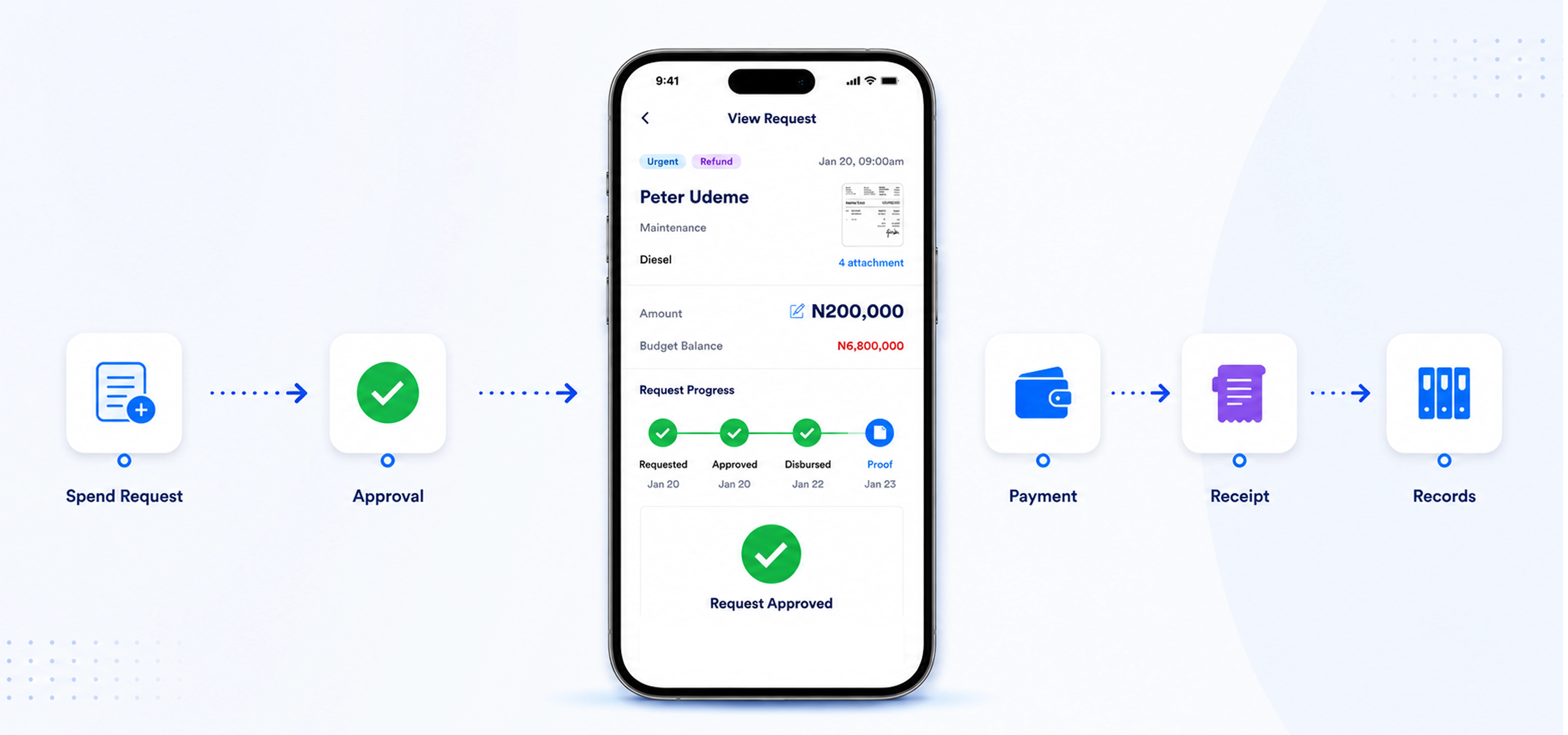
Flex Finance is not trying to replace accounting software.
A better way to think about it is this:
QuickBooks, Sage, Xero, Zoho Books, and Odoo help you keep the books. Flex ensures the spend entering those books is already approved, documented, and traceable.
Flex helps Nigerian businesses manage:
- Expense requests
- Approval workflows
- Multi-level approvals
- Disbursements
- Vendor payments
- Employee reimbursements
- Expense accounts for teams, branches, departments, and projects
- Corporate cards
- Receipts and invoices
- Payment records
- Audit trails
- Finance visibility
This matters because the quality of accounting depends on the quality of the underlying transactions.
How to choose the right tool for your business
The best accounting software depends on what your business needs right now.
Choose QuickBooks if:
You want a widely recognized accounting tool for invoicing, expenses, reports, receipts, and basic financial management.
Choose Sage if:
You want a structured accounting platform with strong recognition among accountants and growing businesses.
Choose Xero if:
You want cloud accounting, integrations, invoicing, reconciliation, and a modern finance experience.
Choose Zoho Books if:
You want affordable accounting software that connects well with the wider Zoho ecosystem.
Choose Odoo if:
You want broader ERP-style functionality across accounting, inventory, CRM, sales, purchases, and operations.
The best setup for many Nigerian businesses
For many Nigerian businesses, the best setup is not one tool.
It is a clear finance stack.
Small business
Use:
- Accounting software for bookkeeping and reports
- Flex for approvals, spend control, disbursements, receipts, and records
Growing SME
Use:
- Accounting software for reporting and compliance
- Flex for expense accounts, team budgets, cards, reimbursements, vendor payments, and audit trails
Multi-branch or multi-team business
Use:
- ERP or accounting software for deeper finance and operations
- Flex for day-to-day spend workflows across teams, branches, departments, projects, and locations
The goal is simple:
Let accounting software record the business. Let Flex manage the spend before it becomes a record.
Final recommendation
The best accounting software in Nigeria depends on your business size, finance team, reporting needs, and operational complexity.
QuickBooks is strong for familiar small business accounting.
Sage is strong for structured accounting.
Xero is strong for cloud accounting and integrations.
Zoho Books is strong for affordable automation.
Odoo is strong for broader ERP-style business management.
But these tools should not be judged only by what they record.
A business also needs to manage how money moves.
That is why growing Nigerian businesses should think beyond accounting software and build a finance workflow that covers the full journey:
Request → Approval → Disbursement → Invoice → Receipt → Record → Report
That is where Flex Finance fits.
Flex helps businesses keep spending approved, documented, visible, and easier to reconcile, so accounting software receives cleaner records from the start.
Because clean accounting does not begin at month-end.
It begins before payment is made.
FAQs
What is the best accounting software in Nigeria?
The best accounting software in Nigeria depends on your needs. QuickBooks, Sage, Xero, Zoho Books, and Odoo are popular options for accounting, invoicing, reconciliation, and reporting. However, many businesses also need spend management software like Flex Finance to manage approvals, disbursements, receipts, reimbursements, and vendor payments before transactions enter the books.
Is QuickBooks good for Nigerian businesses?
QuickBooks can be useful for Nigerian businesses that need invoicing, expense tracking, receipts, reports, and basic bookkeeping. However, businesses with approval workflows, team spending, vendor payments, and reimbursement processes may need a spend management tool alongside QuickBooks.
Is Sage Accounting available for Nigerian businesses?
Yes. Sage has accounting software positioned for Nigerian businesses, including businesses that want to grow locally and internationally. It is useful for structured accounting and reporting, but businesses may still need a separate workflow for spend approvals and disbursements.
Is Xero good for Nigerian businesses?
Xero can be useful for Nigerian businesses that want cloud accounting, invoicing, bank connections, bill payments, reconciliation, and app integrations. It works best when paired with clear internal spend controls.
Is Zoho Books good for SMEs in Nigeria?
Zoho Books can be useful for SMEs that want invoicing, reconciliation, reports, inventory, automation, and user roles. Businesses that already use Zoho products may find it especially attractive.
Is Odoo an accounting software or ERP?
Odoo offers both accounting and broader ERP-style business apps. Its accounting tools can support invoices, vendor bills, reconciliation, reports, budgets, and asset management. Its wider suite can also cover sales, CRM, inventory, purchase, HR, and project management.
Do I need expense management software if I already use accounting software?
Yes, your business requires a spend management system with approvals, disbursements, receipts, reimbursements, vendor payments, or audit trails. Accounting software records transactions. Expense management software like Flex Finance manages the workflow before those transactions become records.
What does Flex Finance do?
Flex Finance helps Nigerian businesses manage business spend in one workflow. Teams can request funds, get approvals, disburse payments, manage expense accounts, use cards, attach receipts, process reimbursements, pay vendors, and keep clearer records for accounting and reconciliation.
What is the biggest mistake businesses make when choosing accounting software?
The biggest mistake is assuming accounting software alone will fix finance operations. If approvals, receipts, disbursements, and reimbursements remain manual, accounting software will only record the issues later. The better approach is to structure the spend workflow before transactions reach accounting.
Share this post







.png)