


Employees need room to move.
A business cannot grow if every small work expense becomes a long internal negotiation.
A sales team may need transport.
A field officer may need money for logistics.
A branch may need operating funds.
A manager may need to pay a vendor.
An employee may need to buy something urgent for work.
A project team may need funds to keep execution moving.
The goal is not to slow people down.
The goal is to give employees spending freedom without losing financial control.
That balance is important for Nigerian businesses.
If employees cannot access funds when work needs to happen, operations slow down.
But if employees spend without structure, finance has to chase receipts, confirm approvals, track reimbursements, explain disbursements, and clean up records at month-end.
The answer is not extreme control.
The answer is structured freedom.
That is where Flex Finance helps.
Flex Finance is an end-to-end spend management platform that helps Nigerian businesses manage the full spend workflow from request to approval to disbursement.
On Flex, employees can request funds; approvals can be granted; finance can disburse funds; receipts and proof of payment can be attached; vendor payments and reimbursements can be managed; and audit trails can remain connected.
Flex is also customizable, so companies of different sizes can configure the platform to align with their own spend policies, approval rules, documentation requirements, departments, branches, projects, and operating structure.
And because Flex has built-in reminders for participants in the approval workflow, finance does not have to chase every pending request manually.
Flex also automatically integrates with QuickBooks, Sage, Xero, Zoho Books, and Odoo, so clean spend records move into accounting without manual work.
The simple idea is this:
Employees should have the freedom to spend for work.
Finance should still have the system to control every naira.
What does employee spending freedom mean?
Employee spending freedom does not mean employees can spend without rules.
It means employees can access the funds they need to do their jobs without unnecessary delay.
A healthy spending process should allow employees to:
- Request money easily
- Get approvals quickly
- Receive disbursements when needed
- Pay for legitimate work expenses
- Submit receipts without stress
- Track reimbursement status
- Move work forward without constant follow-up
But that freedom must sit inside a clear finance workflow.
The business still needs to know:
- Who requested the money
- What the money was for
- Who approved it
- Whether the money was disbursed
- Who received the payment
- Where the receipt is
- Where the payment proof is
- Which team, branch, department, or project owns the expense
- Whether the record has entered accounting
That is the difference between freedom and disorder.
Freedom helps employees move.
Control helps finance explain the movement.
Flex gives businesses both.
Why employee spending becomes difficult as businesses grow
For a very small owner-led business, employee spending can feel simple.
One staff member asks for money.
The owner approves.
The owner makes the payment.
The receipt is saved somewhere for later.
At that stage, the process feels manageable because the business is still close to the owner.
The owner may remember why the money was spent, who asked for it, and whether the receipt was sent.
But as the business grows, memory stops being a system.
More employees request money.
More vendors need payment.
More branches need operating funds.
More teams need budgets.
More managers become approvers.
More receipts need to be collected.
More reimbursements need to be processed.
More reports are expected.
What worked when one owner could remember everything starts to break when the business needs a system that can remember for everyone.
That is why growing businesses need a better way to manage employee spending.
The problem is not employee spending
Employee spending is not the problem.
In many businesses, employee spending is necessary.
Employees spend because work needs to happen.
A field officer cannot wait three days for transport approval.
A sales team cannot delay a client visit because of petty expense friction.
A branch cannot pause small operational needs because finance is chasing signatures.
A project team cannot lose momentum because every spend request is stuck in chat.
The problem is not that employees need money.
The problem is when employee spending happens without a connected workflow.
That is when finance starts dealing with:
- Missing receipts
- Unclear approvals
- Manual reimbursements
- Scattered payment proof
- Untracked staff advances
- Unclear department ownership
- Delayed expense reports
- Month-end follow-ups
- Manual accounting entry
The better approach is to make spending easier for employees and clearer for finance.
Flex helps with that balance.
Why strict control can slow teams down
Some businesses respond to expense problems by making spending harder.
Every request needs too many manual steps.
Every small payment waits for the owner.
Every reimbursement requires multiple follow-ups.
Every expense becomes a back-and-forth conversation.
This may feel like control.
But it can slow the business down.
When approval processes are too manual, employees may delay work, avoid spending even when necessary, or find informal ways around the process.
That creates another problem.
Finance may think it has control, but the business becomes slower and the records may still be scattered.
Good expense control should not make work harder.
It should make responsible spending easier.
Employees should know how to request money.
Managers should know how to approve.
Finance should know what was approved.
Disbursement should be connected.
Receipts and proof should have a home.
Accounting records should be clean.
That is structured freedom.
Why too much freedom creates finance stress
The opposite problem is giving employees spending access without enough structure.
This can look fast at first.
Employees ask on WhatsApp.
Managers approve quickly.
Finance pays from a bank app.
Receipts come later.
Records are updated manually.
But the hidden work shows up later.
Finance has to ask:
Who approved this?
What was it for?
Has it been paid?
Where is the receipt?
Which department owns it?
Was this reimbursed?
Was this vendor payment documented?
Has this entered accounting?
When spending freedom does not come with a clear workflow, finance becomes the department that has to reconstruct the story.
That is not sustainable.
Employees need freedom.
Finance needs control.
The business needs both.
Employee spending freedom vs expense control
The best businesses do not choose between speed and control.
They design a workflow that gives them both.
The goal is simple:
Give employees room to move, but keep every expense traceable.
The real employee spend workflow
Employee spending should not begin at month-end.
It should not begin when the accountant asks for receipts.
It should begin when the employee needs money for work.
A strong employee spend workflow looks like this:
Request → Approval → Disbursement → Receipt → Payment proof → Audit trail → Accounting integration
This workflow gives everyone clarity.
The employee knows how to request funds.
The manager knows what to approve.
Finance knows what to disburse.
The receipt stays attached.
The accountant gets cleaner records.
Leadership sees spending more clearly.
Flex manages this workflow end-to-end.
That is how businesses give employees freedom without losing control.
How Flex gives employees spending freedom
1. Employees can request funds clearly
Instead of sending scattered messages, employees can submit spend requests on Flex.
A request can include:
- Amount
- Purpose
- Category
- Department
- Branch
- Project
- Vendor or payee
- Supporting document
- Required approval
- Date
This makes the request clear from the beginning.
Employees do not need to explain the same thing repeatedly.
Finance does not need to guess what the money is for.
2. Approvals can happen faster and with structure
Flex helps businesses route approvals to the right people.
Approval rules can depend on:
- Amount
- Expense type
- Department
- Branch
- Project
- Employee role
- Manager
- Business policy
This helps managers approve faster without losing control.
Instead of informal approvals living across WhatsApp, email, and paper, the approval stays connected to the spend request.
3. Built-in reminders keep approval workflows moving
One of the reasons finance teams end up chasing people is that approvals get stuck.
A request is submitted.
The approver is busy.
Finance follows up manually.
The employee keeps asking for updates.
The work slows down.
Flex helps reduce this with built-in reminders for participants in the approval workflow.
This keeps requests moving without turning finance into the reminder department.
Employees get better visibility.
Approvers are prompted to act.
Finance spends less time chasing.
The business keeps work moving without losing control.
That is how Flex supports both speed and discipline.
4. Flex can be customised to your company’s spend policy
Every company has its own way of managing spend.
A small owner-led business may only need simple approval rules.
A growing SME may need approvals by department, branch, amount, or project.
A larger company may need multi-level approvals, documentation rules, expense accounts, reimbursement policies, card limits, and accounting mappings.
Flex is customizable, so companies of different sizes can configure the platform around how they actually operate.
This means the business can define:
- Who can request money
- Who approves each type of spend
- What approval limits apply
- What documents are required
- Which teams, branches, departments, or projects own the expense
- How reimbursements should work
- How staff advances should be tracked
- What should sync into accounting
This is important because good expense control should not force every business into the same workflow.
Flex gives companies structure, but still allows them to reflect their own spend policy.
5. Disbursement happens in the same workflow
This is one of the most important differences.
The workflow does not stop at approval.
Once a request is approved, finance can disburse funds through Flex.
That means the request, approval, and payment stay connected.
The business does not need to approve in one place, pay in another, and reconstruct the record later.
6. Employees can submit receipts without making finance chase
Receipt collection becomes easier when it is part of the expense workflow.
Employees can attach receipts, invoices, or supporting documents to the record.
Finance does not need to search through chats, emails, phone galleries, or screenshots.
The receipt stays with the expense.
This is how receipt chasing reduces.
7. Reimbursements become easier to manage
Sometimes employees use personal funds for business expenses.
That can be normal.
But reimbursement should not become a manual back-and-forth process.
With Flex, employees can submit reimbursement claims, attach receipts, get approval, and receive payment through a structured workflow.
Finance can track what has been submitted, approved, paid, or still pending.
The employee gets clarity.
Finance gets a clean record.
8. Staff advances can be tracked properly
Staff advances are common in Nigerian businesses.
Employees may receive advances for field work, travel, procurement, logistics, or branch operations.
But advances need retirement.
Finance needs to know whether the money was used for the approved purpose, whether receipts were submitted, and whether any balance remains.
Flex helps connect the request, approval, disbursement, documentation, and follow-up.
That gives staff advances a stronger trail.
9. Expense accounts give teams controlled access
Some teams, branches, departments, or projects need regular access to funds.
Flex helps businesses manage expense accounts so teams can operate without finance losing visibility.
This is useful for:
- Branch operations
- Field teams
- Project teams
- Sales teams
- Logistics teams
- Department budgets
- Location-based spending
Employees get the flexibility to work.
Finance gets visibility into where money is going.
10. Corporate cards can be managed with control
Corporate cards can help employees spend faster for approved business needs.
But cards need controls.
Flex helps businesses manage card spend with visibility, documentation, and records.
Card activity can be connected to receipts, categories, teams, and audit trails.
That gives employees flexibility without turning card spend into a blind spot.
11. Accounting records move automatically
Flex integrates automatically with QuickBooks, Sage, Xero, Zoho Books, and Odoo.
That means approved, documented, and categorized employee expense records can move into accounting without manual work.
Finance does not need to rebuild the record.
Accounting receives cleaner data.
Month-end close becomes easier.
Flex turns spend policy into a working system
Many companies have spend policies.
The challenge is making sure the policy works in daily operations.
A policy document may say who should approve what.
It may define spending limits.
It may explain what receipts are required.
It may describe reimbursement rules.
But if the policy only lives in a document, finance still has to enforce it manually.
That creates avoidable follow-up.
Flex helps companies turn spend policy into a working system.
The policy becomes part of the workflow.
Requests follow the right route.
Approvers receive reminders.
Disbursements stay connected.
Receipts and proof are attached.
Accounting records are cleaner.
That is the difference between having a spend policy and operating with spend control.
How to give spending freedom without losing control
1. Define what employees can spend on
Employees need clarity.
The business should define approved expense categories.
Examples include:
- Transport
- Fuel
- Internet
- Airtime
- Field operations
- Logistics
- Travel
- Client meetings
- Office supplies
- Project expenses
- Branch expenses
- Procurement support
When employees know what is allowed, spending becomes easier to manage.
2. Define what needs approval before spending
Not every expense should happen before approval.
The business should decide which expenses require approval first.
Examples include:
- Vendor-related expenses
- Travel costs
- Large transport or logistics costs
- Procurement requests
- Project expenses
- Branch operating expenses
- Staff advances
This keeps spending flexible but responsible.
3. Set approval rules by amount and team
Approval rules should not be vague.
The business can define approval rules based on:
- Amount
- Department
- Branch
- Project
- Vendor type
- Employee role
- Expense category
- Urgency
This helps employees know what to expect.
It also helps managers and finance avoid unnecessary back-and-forth.
Flex can be configured around these rules, so the policy becomes part of the spend workflow.
4. Use reminders to keep approvals from getting stuck
Even the best approval policy can slow down when approvers forget to act.
That is why reminders matter.
Built-in reminders help approval participants stay aware of pending requests.
This helps employees move faster and reduces manual follow-up for finance.
The result is a better experience for everyone involved in the workflow.
5. Make receipts part of the process
Receipts should not be treated as something finance begs for later.
They should be part of the workflow.
The rule should be simple:
If an employee spends company money or requests reimbursement, the supporting document should be attached to the expense record.
Flex makes this easier because the receipt stays connected to the request, approval, and disbursement.
6. Keep disbursement connected to approval
Approval and payment should not live in different places.
If a manager approves in one tool and finance pays in another, the record becomes weaker.
Flex keeps approval and disbursement together.
This gives finance a clearer trail and makes reporting easier.
7. Assign every expense to an owner
Every employee expense should have an owner.
This may be:
- Employee
- Manager
- Department
- Branch
- Project
- Location
- Budget holder
Ownership helps the business understand where money is going.
It also makes management reporting more useful.
8. Review expenses before month-end
Finance should not wait until the end of the month to check employee expenses.
A weekly review can help catch:
- Missing receipts
- Pending approvals
- Unpaid reimbursements
- Unretired advances
- Uncategorized expenses
- Unclear expense ownership
- Failed disbursements
This makes month-end close easier.
What finance teams should avoid
1. Do not make employees wait unnecessarily
Control should not become a bottleneck.
A good system should help employees request money and get approval faster, not make them avoid the process.
2. Do not let employee spending live only in messaging tools or manual channels
WhatsApp is only one example.
Many companies manage employee spending across messaging tools and manual processes such as WhatsApp, email, Microsoft Teams, Slack, paper forms, screenshots, spreadsheets, and bank apps.
These tools can support communication and documentation, but they should not become the main system for spend control.
Employee spend requests, approvals, disbursements, receipts, payment proof, and audit trails should not be scattered across different channels.
3. Do not separate approval from disbursement
If approval and payment happen in different places, finance has to reconnect them later.
That creates extra work.
4. Do not collect receipts only at month-end
By month-end, receipts are already late.
Receipt collection should happen during the spend workflow.
5. Do not manage reimbursements manually
Manual reimbursements create delays, repeated follow-ups, and weak records.
A clear workflow helps employees and finance.
6. Do not record expenses without ownership
Every expense should show who owns it.
Without ownership, reports become less useful.
7. Do not keep your spend policy outside your spend system
If the company has a spend policy but the workflow does not enforce it, finance still has to manage compliance manually.
The better approach is to configure the spend system around the policy.
That is what Flex helps companies do.
Employee spending freedom without Flex vs with Flex
This is how Flex helps businesses move faster without losing financial discipline.
Why this matters for Nigerian businesses
Nigerian businesses often operate in real conditions that require speed.
Teams need transport.
Vendors need transfers.
Field officers need operating funds.
Branches need local spending.
Employees need reimbursements.
Projects need quick execution.
A finance system that is too slow can frustrate operations.
But a spending process that is too loose can frustrate finance.
Flex helps solve both sides.
Employees get a clearer way to request and receive funds.
Approvers get reminders that keep workflows moving.
Companies can customize the platform around their spend policies.
Finance gets a clearer way to approve, disburse, document, track, reconcile, and report.
That is the balance growing businesses need.
For some businesses, Flex alone is already a major upgrade
Not every business needs a complex finance stack on day one.
For many businesses, the biggest upgrade is simple:
Can every employee expense be requested, approved, disbursed, documented, and traced in one place?
If the answer is yes, that business already has a stronger finance foundation than many companies.
For a very small owner-led business, employee spending may feel manageable.
One staff member asks for money.
The owner approves.
The owner makes the payment.
The receipt is saved somewhere.
But as soon as the business adds more people, more vendors, more teams, more expense types, and more reporting expectations, memory stops being a system.
The business needs a workflow that remembers for everyone.
That is what Flex provides.
Because Flex is customizable, it can serve businesses at different stages.
A small business can start with simple approval rules.
A growing company can add department, branch, project, and amount-based workflows.
A larger business can configure more advanced approval structures, documentation requirements, expense accounts, card policies, and accounting integrations.
For smaller businesses, Flex can become the first major step into structured finance operations.
For growing businesses, Flex strengthens accounting software through automatic integration.
For larger businesses, Flex supports ERP by keeping spend workflows controlled, visible, and connected.
Best finance workflow for employee spending
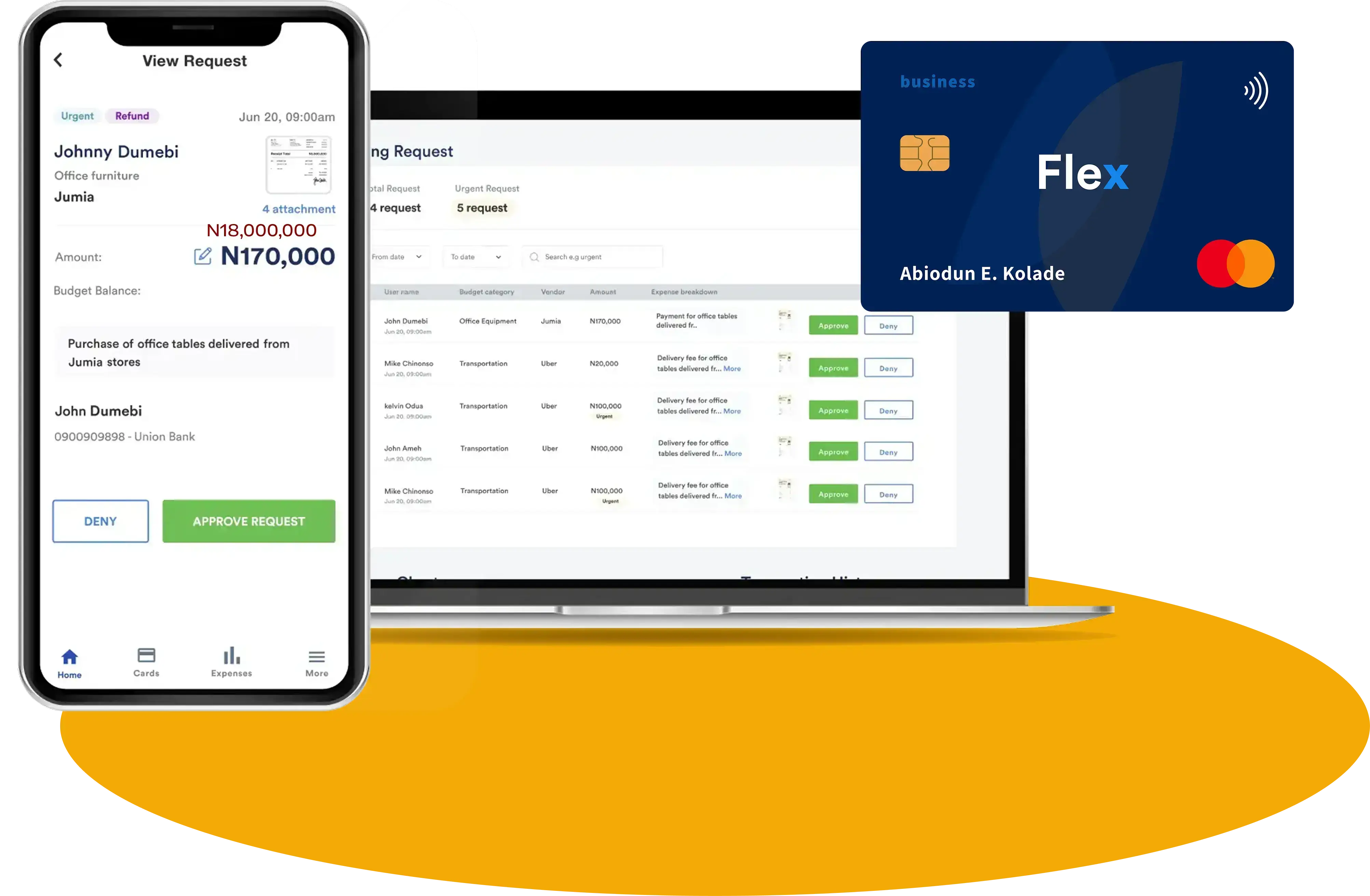
The strongest workflow is simple.
Use Flex for employee spend management
Use Flex to manage:
- Employee expense requests
- Approval workflows
- Built-in approval reminders
- Custom spend policies
- Disbursements
- Reimbursements
- Staff advances
- Expense accounts
- Corporate cards
- Receipts
- Payment proof
- Audit trails
- Spend visibility
- Automatic accounting integration
Use accounting software for books and reports
Use QuickBooks, Sage, Xero, Zoho Books, or Odoo to manage:
- Bookkeeping
- Reconciliation
- Accounting entries
- Financial statements
- Reports
- Tax records
- Profit and loss
- Balance sheet
- Cash flow
Use messaging apps for communication only
Use WhatsApp, email, Slack, or Teams for:
- Clarifications
- Reminders
- Updates
- Follow-ups
- Team coordination
This is the better finance stack:
Messaging tools handle conversations.
Flex manages employee spending from request to disbursement.
Accounting software records money and supports reporting.
Final recommendation
Employees should be able to move fast when work needs to happen.
Finance should still be able to track, approve, disburse, document, reconcile, and report every expense clearly.
That is the balance every growing business needs.
The answer is not to remove employee spending freedom.
The answer is to give that freedom a proper workflow.
Flex Finance helps Nigerian businesses manage the full spend workflow from request to approval to disbursement.
With Flex, employees can request funds, managers can approve, finance can disburse, receipts and payment proof can stay attached, reimbursements and staff advances can be managed, and audit trails can remain connected.
Flex also helps companies customize spend workflows around their own policies, approval limits, documentation requirements, departments, branches, projects, and operating structure.
And with built-in reminders for approval participants, Flex helps keep requests moving without making finance chase every approver manually.
Then Flex integrates automatically with QuickBooks, Sage, Xero, Zoho Books, and Odoo, so clean employee expense records move into accounting without manual work.
Accounting software can help record the expense.
Flex helps make sure the expense is clean before it becomes a record.
The conclusion is simple:
Give employees the freedom to spend for work.
Give finance the system to control it.
And if employee spending involves company money, it should happen on Flex.
That is how Nigerian finance teams can move from receipt chasing to structured freedom, cleaner records, faster approvals, easier reconciliation, and stronger financial control.
FAQs
What does employee spending freedom mean?
Employee spending freedom means employees can access funds for legitimate work expenses without unnecessary delay, while the business still keeps approval, disbursement, receipts, payment proof, and audit trails connected.
How can businesses give employees spending freedom without losing control?
Businesses can do this by using a structured spend workflow. Employees request funds, managers approve, finance disburses, receipts are attached, and records move into accounting.
Why do finance teams chase receipts?
Finance teams chase receipts when documentation is collected after money has already moved. A better process makes receipts part of the expense workflow from the beginning.
How does Flex help employee spending?
Flex helps employees request funds, managers approve, finance disburse money, receipts and payment proof stay attached, and clean records move into accounting automatically.
Can Flex be customized to a company’s spend policy?
Yes. Flex is customizable, so companies can configure approval rules, documentation requirements, spending limits, departments, branches, projects, reimbursement workflows, expense accounts, and accounting mappings around their own spend policy.
Does Flex have reminders for approvals?
Yes. Flex has built-in reminders for participants in the approval workflow, helping requests move without finance manually chasing every approver, and employees who requested for funds are updated how they request is moving in the approval chain.
Does Flex help with employee reimbursements?
Yes. Flex helps businesses manage employee reimbursements from request to approval to disbursement, with receipts, payment proof, and audit trails connected.
Does Flex help with staff advances?
Yes. Flex helps businesses manage staff advances by connecting request, approval, disbursement, supporting documents, receipts, and tracking in one workflow.
Does Flex handle disbursements?
Yes. Flex helps businesses manage disbursements as part of the same workflow, so request, approval, payment, documentation, and audit trail stay connected.
Does Flex integrate with accounting software?
Yes. Flex integrates automatically with QuickBooks, Sage, Xero, Zoho Books, and Odoo, so approved, documented, and categorized employee expense records can move into accounting without manual work.
Can employees still use WhatsApp or email?
Yes. Employees can still use WhatsApp or email for communication, reminders, and clarifications. But the actual spend request, approval, disbursement, receipt, and audit trail should happen on Flex.
What is the best employee spending setup for Nigerian businesses?
A strong setup is Flex Finance for employee spend management, accounting software for books and reports, and messaging apps for communication only.
Share this post








.png)