As Nigeria advances towards a more digitally connected tax administration system, the relationship between business transactions, financial documentation and regulatory reporting is evolving. Flex Finance is contributing to this transformation by making the financial processes behind business expenditure more intuitive, transparent and connected.
Every invoice tells a financial story. The most useful business records tell the story behind it.
A supplier delivers equipment to a manufacturing company. The invoice identifies the goods, their value and the applicable taxes. But within the enterprise, that transaction also represents a series of commercial decisions.
Someone identified the requirement. A budget was allocated. An authorised manager approved the expenditure. The supplier fulfilled the order, and the finance team arranged payment.
Each stage contributes to the financial history of the transaction.
For businesses, the ability to connect these activities is fundamental to effective financial management. For tax administration, accurate and accessible transaction records provide an important foundation for transparency, verification and reporting.
Nigeria is making significant progress towards a financial environment in which this information can move more efficiently between businesses, their financial systems and tax authorities.
The Nigeria Revenue Service (NRS) is advancing the country's Electronic Fiscal System (EFS), a major initiative designed to modernise tax administration through electronic invoicing and structured transactional reporting.
At the centre of the initiative is the Merchant Buyer Solution (MBS), which enables the electronic creation, exchange, validation and reporting of invoices through compatible digital systems.
The development is part of a wider transformation in Nigeria's financial infrastructure.
The country has already established one of Africa's most sophisticated real-time payments ecosystems, with transaction volumes that have placed it among the world's leading instant-payment markets. Its progress towards open banking has created a regulatory foundation for more connected financial services.
Electronic invoicing represents another important stage in this evolution.
Nigeria is extending the sophistication of its financial infrastructure from the movement of money to the information that gives commercial transactions their meaning.
For businesses, that progress creates an opportunity to strengthen the relationship between everyday financial operations and the records through which those activities are ultimately reported.
It is within this wider evolution that Flex Finance, an established spend management technology company serving African enterprises, plays a complementary role.
A significant advancement in Nigeria's financial architecture
Nigeria's modernisation of tax administration is a consequential development in the country's digital economy.
Through the Electronic Fiscal System, the Nigeria Revenue Service is establishing a more standardised approach to the creation, validation and exchange of commercial invoices.
The Merchant Buyer Solution supports structured electronic invoicing, enabling businesses to issue and receive digital documents using established technical standards.
Unlike a scanned paper invoice or an ordinary PDF attachment, a structured electronic invoice contains information organised for processing by compatible digital systems.
This distinction is important.
Standardised information can be exchanged and validated more consistently across different software environments. Businesses can integrate invoicing activities more closely with their accounting systems, while tax authorities gain improved visibility into relevant transactions.
The framework supports the exchange of invoices between businesses and incorporates mechanisms for digital validation and fiscal reporting.
It also accommodates different types of commercial documents, including invoices, credit notes and debit notes.
These capabilities reflect international developments in digital tax administration, where electronic reporting, interoperability and structured financial data are becoming increasingly important.
Nigeria's adoption of these approaches demonstrates the country's commitment to developing sophisticated financial infrastructure that supports both public administration and private enterprise.
The implementation is being introduced progressively.
Nigeria’s electronic invoicing rollout follows a tiered implementation schedule designed to help businesses transition without disruption.
The Federal Inland Revenue Service started the mandate with large corporate taxpayers, focusing initial onboarding on companies with an annual turnover above ₦5 billion. Medium enterprises earning between ₦200 million and ₦5 billion join in subsequent phases, while smaller businesses follow later to give them enough time to set up compliant digital billing systems.
This phased schedule allows organisations to update their accounting setups at a manageable pace. Moving to electronic invoicing also helps companies connect their day-to-day sales directly to statutory filing, making financial recordkeeping cleaner and tax reporting far more efficient.
The financial record begins before the accounting entry
Modern enterprises generate substantial volumes of financial information.
A manufacturing company may purchase raw materials, maintain production equipment and coordinate payments across several facilities.
A logistics business may manage transport expenses, supplier relationships, vehicle maintenance and operational budgets across multiple locations.
A retail group may coordinate purchases and financial responsibilities across dozens of branches.
Each organisation relies on accurate accounting.
But the information required for effective financial management begins with the commercial activities that produce the accounting entries.
Consider a company operating a factory in Ogun State, two warehouses in Lagos and a distribution centre in Abuja.
The company purchases equipment for its factory. A supplier issues an invoice, the responsible manager authorises the expenditure, and the finance department processes payment.
For accounting purposes, the organisation needs the appropriate transaction details and supporting documents.
For management purposes, it also benefits from knowing why the purchase was made, which department authorised it, how it relates to the approved budget and whether payment has been completed.
For tax purposes, the business must maintain the documentation required under the applicable rules, including valid tax invoices where relevant.
These are related but distinct information requirements.
A well-organised financial environment allows the appropriate information to be available to the people and systems responsible for each purpose.
The importance of this connection becomes clearer as organisations expand.
A finance director responsible for several business locations needs consistent financial information across the enterprise.
An accountant preparing returns needs access to appropriate transaction records.
An operations manager needs a straightforward way to initiate authorised expenditure and supply supporting documentation.
Each participant contributes to the quality of the organisation's financial information.
When these activities are connected, the business benefits from a more reliable foundation for accounting, reporting and financial decision-making.
This is where business spend management adds a valuable dimension to the modern enterprise technology environment.
The role of spend management in a digitally connected tax environment
Business spend management concerns the processes through which an organisation plans, authorises, executes and records expenditure.
It connects the people responsible for spending decisions with the financial systems used to manage company resources.
An employee requests money for a legitimate operational purpose. A designated manager reviews the requirement. The expenditure is evaluated against an established budget. Finance executes the approved payment, while supporting documentation becomes part of the transaction record.
This sequence is a routine part of commercial activity.
Its organisation has implications for the accuracy and usefulness of a company's financial information.
Spend management brings greater continuity to the relationship between financial decisions and transactions.
It provides businesses with a structured environment for organising approvals, payments, receipts and expenditure records.
Accounting systems subsequently use financial information to support bookkeeping, reconciliation, reporting and the preparation of financial statements.
Specialist electronic invoicing systems address the separate requirements of issuing, exchanging and validating invoices in accordance with applicable tax rules.
These technologies have complementary responsibilities.
Banks and payment infrastructure facilitate financial transactions. Accounting software maintains the books. Electronic fiscal systems support prescribed invoice validation and reporting. Spend management connects the everyday decisions and activities through which company expenditure takes place.
Their combined value is greater financial continuity.
An organisation can maintain established accounting software, adopt appropriate electronic invoicing solutions and use a dedicated spend management platform to organise expenditure across its workforce.
This creates a more connected financial operating environment in which different systems contribute to a coherent record of commercial activity.
Better financial reporting begins with better financial information. And better financial information begins with the way businesses organise their transactions.
For enterprises participating in Nigeria's evolving digital tax environment, that principle deserves particular attention.
Flex Finance and the financial processes behind the numbers
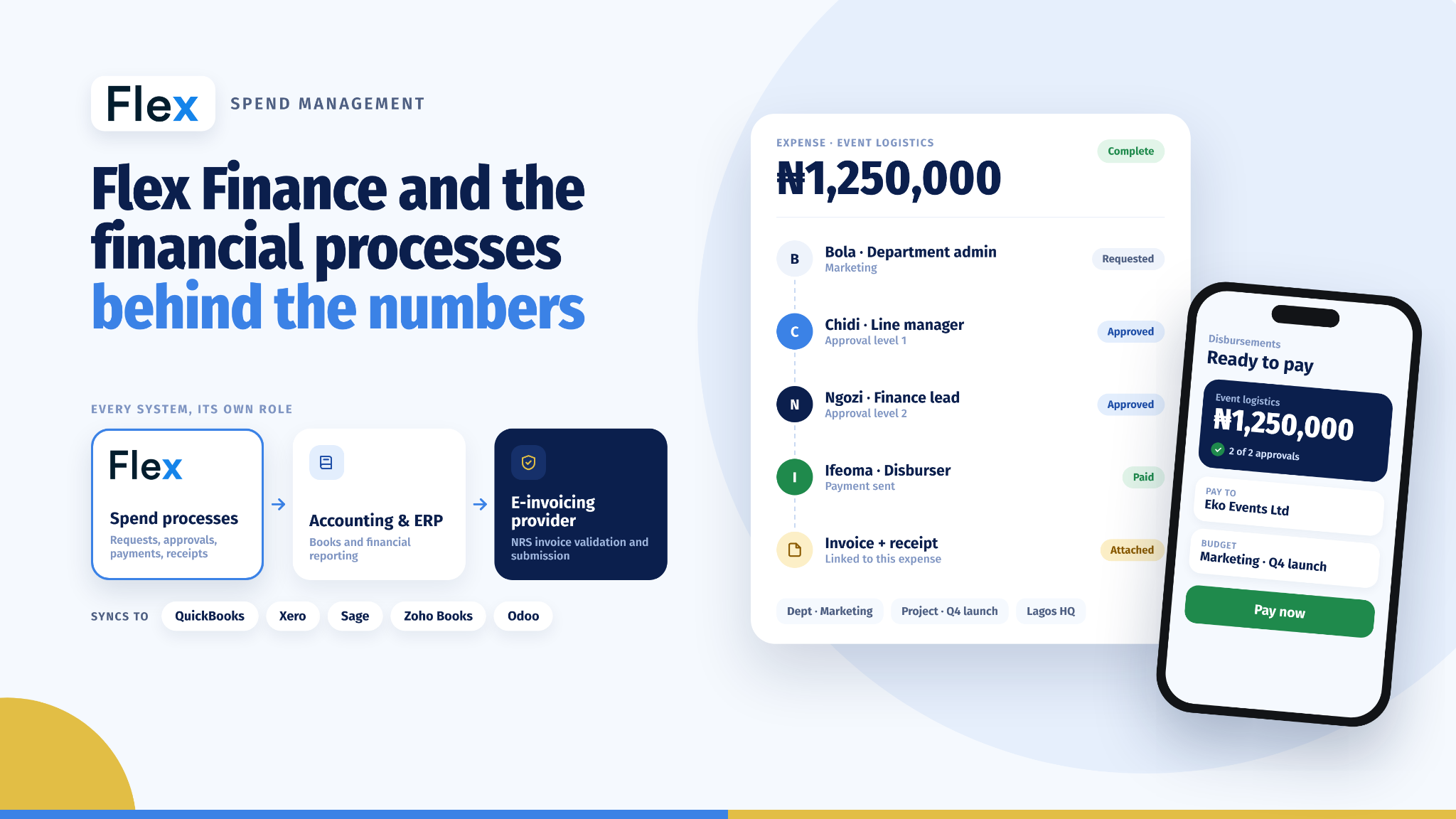
Flex Finance has established its platform around a central requirement of enterprise financial management: making the movement of company money clear, authorised and accountable.
Its software connects expense requests, multilevel approvals, disbursements, corporate cards, budgets, receipts and financial records within a single spend management environment.
The platform is designed to make sophisticated financial processes intuitive for employees, operational managers and finance teams alike.
A department administrator can request funds for a business expense.
The appropriate manager can review the purpose and amount, with the approval process reflecting the organisation's financial policies.
A designated disburser can complete the payment, while the corresponding records and supporting documentation remain connected to the expenditure.
Finance teams can organise spending across departments, projects and business locations, maintaining visibility over how financial resources are allocated throughout the enterprise.
For larger organisations, these capabilities become especially valuable.
A business operating multiple branches may distribute spending responsibilities across regional managers while maintaining consistent financial oversight from its headquarters.
A manufacturing enterprise may assign budgets to different facilities, ensuring that operational teams can carry out authorised activities within an established financial structure.
A professional services company may organise expenditure according to projects, departments and management responsibilities.
Across these activities, Flex provides a connected record of the spending process.
The platform also integrates with established accounting solutions, including QuickBooks, Xero, Sage, Zoho Books and Odoo.
This interoperability allows businesses to connect their day-to-day spending activities with the systems used for bookkeeping and financial reporting.
The distinction is central to Flex's position within enterprise financial technology.
Accounting platforms and enterprise resource planning systems perform essential roles in managing financial information. Flex complements them by making the processes behind business expenditure more accessible and connected.
For employees, the experience is intuitive.
For managers, financial responsibilities remain structured.
For accountants, the supporting information associated with spending becomes easier to access and organise.
For business leaders, expenditure across different parts of the organisation becomes more visible.
The benefit extends naturally to businesses strengthening their internal documentation practices as Nigeria advances its digital tax administration agenda.
Flex supports the financial operating records that businesses use alongside their accounting and tax systems, while specialised electronic invoicing providers handle the technical requirements of NRS invoice validation and submission.
This division of responsibilities reflects the increasingly sophisticated nature of modern enterprise finance.
The objective is a financial environment in which every system performs its role, and the business benefits from information that remains connected throughout the transaction lifecycle.
Why intuitive financial software matters for larger businesses
One of the important developments in enterprise technology is the recognition that financial systems must serve people with different responsibilities and levels of technical expertise.
A company's financial processes involve more than accountants.
Production managers authorise operational requirements. Procurement officers coordinate purchases. Warehouse supervisors manage facility expenditure. Regional directors oversee budgets. Employees incur business expenses that must be recorded and reimbursed.
Each of these activities contributes information to the organisation's financial records.
The quality of the resulting information is influenced by how naturally employees can participate in established processes.
A financial system becomes more effective when an employee can submit a request without needing detailed accounting knowledge.
An approval becomes more useful when managers can understand its business purpose and financial implications.
A payment record becomes more informative when the associated documentation and authorisation history are readily available.
These are principles of intuitive software design.
They make sophisticated business processes accessible across the organisation while preserving the responsibilities of finance professionals.
Flex Finance's approach reflects this philosophy.
Its mobile and web platforms allow operational employees, managers and finance teams to participate in connected spending workflows according to their responsibilities.
The resulting information can support financial oversight across business locations, departments and projects.
For growing enterprises, this balance between accessibility and structure is important.
As businesses expand, financial responsibilities become distributed across more people and operating units.
An intuitive spending environment allows employees to undertake their responsibilities while maintaining the documentation and oversight expected of a mature organisation.
This is particularly relevant in an economy where businesses are investing in additional facilities, opening branches and developing increasingly sophisticated management structures.
The value of technology lies in making these larger organisations easier to operate.
Stronger financial records, stronger enterprises
Nigeria's digital tax administration agenda forms part of a wider movement towards better-organised commercial information.
The immediate focus of electronic invoicing is the creation, validation and exchange of structured transaction documents.
The broader enterprise opportunity lies in strengthening how businesses organise financial information throughout their operations.
Consider the value of a transaction record that connects its original purpose, authorisation, payment and supporting documentation.
It can assist the accountant responsible for reconciling expenditure.
It can provide management with information about spending patterns and budget utilisation.
It can support internal review processes and provide context when appropriate records are needed for audit or tax administration.
It can also help a business maintain consistent financial practices as its operations become more geographically distributed.
These benefits are significant because financial information serves multiple purposes.
It supports statutory reporting, but it is equally important to commercial management.
Businesses use financial information to evaluate performance, allocate capital, assess operating requirements and plan future investment.
The stronger the underlying records, the more useful that information becomes.
For Nigeria's enterprise sector, the continued adoption of sophisticated financial technology creates opportunities to develop these capabilities across a wider range of businesses.
And as financial administration becomes more digitally connected, enterprises can increasingly design their internal systems around the quality, accessibility and continuity of financial information.
A Nigerian foundation with an African outlook
Nigeria's advances in digital payments, open banking regulation and electronic tax administration reflect the maturity of its financial technology ecosystem.
That maturity provides an important foundation for enterprise software companies serving the continent.
As Africa's largest national market by population, Nigeria brings together businesses spanning manufacturing, logistics, agriculture, energy, retail, financial services and technology.
Many operate across multiple locations, while others are extending their commercial activities into additional African markets.
The operating requirements of these businesses create demand for sophisticated financial software that can support larger and more distributed organisations.
Flex Finance's experience in the Nigerian market has informed a platform developed around the everyday financial responsibilities of such enterprises.
Its international outlook follows the regional growth of the businesses it serves.
As African companies expand across countries, the importance of consistent spending authorisation, budget oversight, transaction documentation and financial reporting becomes increasingly apparent.
Each market has its own tax framework, reporting requirements and financial infrastructure.
The underlying business requirement for clear financial processes remains relevant across them.
For Flex, this creates an opportunity to deliver internationally relevant spend management software while complementing the banking, accounting and tax systems applicable to each market.
It also represents a contribution to the development of African enterprise technology.
Sophisticated software developed through practical experience in one of the continent's largest markets can serve businesses with similar operating requirements elsewhere.
As these products develop, they contribute to the continent's technical capabilities, intellectual property and expanding digital services industry.
The result is an enterprise technology ecosystem that supports business productivity while creating economic value of its own.
The lasting value of digital tax modernisation
Nigeria's transition towards electronic invoicing represents an important stage in the modernisation of its financial administration.
It builds upon the country's achievements in payments infrastructure and reflects a growing emphasis on interoperability, standardised information and digitally connected financial services.
For the Nigeria Revenue Service, the development supports more efficient administration and greater visibility into relevant commercial transactions.
For businesses, it creates an opportunity to strengthen the quality of the financial information moving through their systems.
And for the wider economy, it contributes to the development of a more sophisticated environment for commercial activity.
The lasting value of this transformation will extend beyond the adoption of electronic documents.
It will also be reflected in the capabilities businesses develop around them: reliable financial records, more connected operating processes and technology that makes sophisticated financial management increasingly accessible.
Flex Finance is contributing to that evolution through intuitive spend management software that connects the decisions, payments and documentation behind everyday business expenditure.
Its role complements Nigeria's established banking, accounting and emerging electronic fiscal infrastructure, strengthening the financial processes through which enterprises organise their operations.
As Nigerian businesses become larger, more productive and increasingly international, these capabilities will remain relevant to their growth.
The future of financial administration is increasingly digital. The strength of that future will depend on the quality of the business information flowing through it.
And the most useful financial record is one that tells the full story of the transaction it represents.
About Flex Finance
Flex Finance is a spend management technology company providing intuitive financial operating software for businesses across Africa. The platform connects expense requests, approvals, disbursements, corporate cards, budgets, receipts, financial records and accounting integrations, helping organisations manage company spending across departments, projects, teams and business locations.
Share this post