


Vendor payments should not be treated as ordinary bank transfers.
A vendor payment carries a business story.
Who requested the payment?
What was the vendor engaged for?
Was there an invoice?
Who approved the payment?
Which department, branch, project, or budget owns the cost?
Was the vendor paid?
Where is the payment proof?
Has the transaction moved into accounting?
For a very small owner-led business, this can feel simple.
One staff member sends an invoice.
The owner approves.
The owner makes the transfer.
The payment proof is saved somewhere.
At that stage, the owner may remember everything.
But as the business grows, memory stops being a system.
More vendors need to be paid.
More employees submit requests.
More invoices arrive.
More managers need approval authority.
More branches and departments spend.
More payment proof needs to be collected.
More reports are expected from finance.
That is when vendor payments become harder to manage.
The problem is not only paying vendors.
The real challenge is managing the full vendor payment workflow from request to approval to payment proof.
That is where Flex Finance helps.
Flex Finance is an end-to-end spend management platform that helps Nigerian businesses manage the full spend workflow from request to approval to disbursement.
On Flex, teams can request vendor payments, attach invoices, route approvals, disburse funds, attach payment proof, manage vendor records, keep audit trails connected, and sync clean records into accounting.
Flex is also customizable, so companies of different sizes can configure the platform around their own spend policies, approval rules, vendor payment limits, documentation requirements, departments, branches, projects, and operating structure.
And because Flex has built-in reminders for participants in the approval workflow, vendor payment requests do not have to sit idle while finance manually chases every approver.
Then Flex automatically integrates with QuickBooks, Sage, Xero, Zoho Books, and Odoo, so clean vendor payment records move into accounting without manual work.
The simple idea is this:
Bank apps help you send money.
Flex helps you control the vendor payment workflow.
What is vendor payment software?
Vendor payment software helps businesses manage payments to suppliers, contractors, service providers, agencies, consultants, distributors, and other business vendors.
But the best vendor payment software should do more than move money.
A proper vendor payment system should help the business manage:
- Vendor payment requests
- Invoice attachments
- Approval workflows
- Payment execution
- Payment proof
- Vendor records
- Department, branch, project, or budget ownership
- Audit trails
- Expense categorization
- Accounting integration
This matters because vendor payments affect cashflow, supplier relationships, financial reporting, reconciliation, and internal controls.
A growing business needs more than the ability to transfer money.
It needs a clear way to explain every vendor payment.
Why vendor payments become difficult as companies grow
Vendor payments become harder when the payment process is scattered.
A vendor sends an invoice by email.
A staff member discusses it on WhatsApp.
The manager approves in Microsoft Teams or Slack.
Finance pays from a bank app.
Payment proof is saved as a screenshot.
The accountant records the expense later.
Each step may feel normal.
But together, the process creates gaps.
Finance then has to ask:
- Who requested this vendor payment?
- Was the vendor approved?
- Where is the invoice?
- Who approved the payment?
- Was the payment made?
- Where is the proof?
- Which department owns the cost?
- Has this been recorded in accounting?
- Can we explain this transaction later?
This is why vendor payment software should not only focus on payment.
It should manage the full workflow.
The best vendor payment workflow
A strong vendor payment workflow should look like this:
Request → Invoice → Approval → Payment → Proof → Accounting Sync
Each step matters.
1. Request
The request explains why the vendor payment exists.
It should show:
- Who requested the payment
- What the payment is for
- Which vendor should be paid
- Estimated or confirmed amount
- Department, branch, project, or budget owner
- Supporting documents
- Required approval
This gives finance context before money leaves.
2. Invoice
The invoice confirms the vendor’s payment demand.
It should include:
- Vendor name
- Invoice number
- Invoice date
- Amount
- Description of goods or services
- Payment details
- Supporting documents
- Relevant tax or statutory details where applicable
The invoice should not live alone in email or a shared folder.
It should stay connected to the payment request.
3. Approval
Approval confirms that the vendor payment should go ahead.
A good approval trail should show:
- Who approved the payment
- When it was approved
- Whether it followed company policy
- Whether the right department, branch, project, or budget owner approved it
- Whether the amount requires additional approval
- Whether finance reviewed the payment details
Approval should not be scattered across chat, email, paper, or screenshots.
It should be part of the vendor payment record.
4. Payment
After approval, finance can pay the vendor.
This is where the workflow often breaks.
Approval happens in one place.
Payment happens somewhere else.
Proof is saved separately.
Accounting cleanup happens later.
A stronger process connects approval and payment inside the same workflow.
5. Proof
Payment proof confirms that money actually reached the vendor or was sent to the correct recipient.
Payment proof may include:
- Transfer receipt
- Payment confirmation
- Bank transaction reference
- Vendor acknowledgement
- Supporting documents
Proof should stay attached to the vendor payment record.
Finance should not have to search through screenshots, chats, or bank apps later.
6. Accounting sync
Once the vendor payment is approved, paid, documented, and categorized, the record should move into accounting.
Flex integrates automatically with QuickBooks, Sage, Xero, Zoho Books, and Odoo.
This helps finance reduce manual entry, improve reconciliation, and close the month faster.
What growing businesses should look for in vendor payment software
A growing Nigerian business should not choose vendor payment software only because it can make transfers.
Transfers are only one part of the job.
The right platform should help the business manage the full vendor payment process.
1. Structured vendor payment requests
The platform should allow employees or teams to submit vendor payment requests with the right context.
This includes purpose, amount, vendor details, department, branch, project, category, and supporting documents.
Without a structured request, finance may only see the payment when it is already urgent.
2. Invoice attachment
Vendor invoices should stay connected to the payment request.
Finance should not have to search through emails, folders, screenshots, or chats to find the invoice.
The invoice should be part of the payment record.
3. Custom approval workflows
Every business has its own approval policy.
A small business may need simple owner approval.
A growing SME may need department, branch, or amount-based approvals.
A larger business may need multi-level approvals, finance review, documentation rules, and payment limits.
Vendor payment software should be customizable enough to reflect how the company actually operates.
Flex allows companies to configure workflows around their spend policies.
4. Built-in approval reminders
Vendor payments often get delayed because approvals get stuck.
The approver may be busy.
Finance follows up manually.
The vendor keeps asking for payment.
The business loses time.
Good vendor payment software should help keep approval workflows moving.
Flex has built-in reminders for participants in the approval workflow, reducing the need for finance to manually chase approvers.
5. Payment execution
The software should not stop at approval.
If approval happens in one place and payment happens somewhere else, the finance trail becomes weaker.
The right system should connect approval and disbursement.
Flex helps businesses pay vendors as part of the same spend workflow.
6. Payment proof
Vendor payment software should keep payment proof attached to the transaction.
This gives finance and accounting a complete record.
It also helps reduce confusion when vendors ask for confirmation.
7. Vendor payment audit trail
Every vendor payment should have a clear audit trail.
A strong audit trail should show:
- Request history
- Invoice attachment
- Approval history
- Payment status
- Payment proof
- Expense owner
- Accounting sync status
This helps finance explain vendor payments without rebuilding the story later.
8. Department, branch, and project ownership
Vendor payments should not only show vendor name and amount.
They should show who owns the cost.
The owner may be:
- Department
- Branch
- Project
- Location
- Budget holder
- Manager
- Operating unit
This helps management understand where money is going.
9. Accounting integration
Vendor payment software should connect with accounting software.
Flex integrates automatically with QuickBooks, Sage, Xero, Zoho Books, and Odoo.
This helps approved, documented, and categorized vendor payment records move into accounting without manual work.
10. Scalability
The system should support the business as it grows.
A process that works for five vendor payments a month may not work for fifty or five hundred.
The right platform should support:
- More vendors
- More approvers
- More branches
- More departments
- More invoices
- More payment proof
- More reports
- More approval rules
Flex is built to support businesses at different stages, from smaller teams to larger companies with more complex spend policies.
Vendor payment software options: what each one does well
Growing businesses usually consider several options for vendor payments.
Each option has a role.
The question is whether it can manage the full workflow.
Bank apps
Bank apps help businesses move money.
They are useful for transfers.
But bank apps usually do not manage the full vendor payment process.
They may not show:
- Who requested the payment
- Who approved it
- Which invoice supports it
- Which department owns the cost
- Whether payment proof is attached to the invoice
- Whether the record has synced into accounting
A bank app can send money.
But it is not a complete vendor payment workflow.
Spreadsheets
Spreadsheets can help track vendor payments manually.
They are flexible and familiar.
But they usually sit after the payment process.
A spreadsheet may show that a vendor was paid.
But the request, invoice, approval, payment proof, and audit trail may still live elsewhere.
This creates extra work for finance.
Spreadsheets can support analysis.
But they should not be the main system for vendor payment control.
Messaging tools and email
WhatsApp, email, Slack, and Microsoft Teams are useful for communication.
Teams can use them to clarify details, discuss invoices, or follow up.
But the actual vendor payment workflow should not live only inside messaging tools or email.
When approvals, invoices, payment proof, and follow-ups are scattered across conversations, finance has to reconstruct the transaction later.
Messaging tools should support communication.
Flex should manage the vendor payment workflow.
Accounting software
Accounting software is important.
QuickBooks, Sage, Xero, Zoho Books, and Odoo help businesses record transactions, reconcile accounts, and prepare reports.
But accounting software should not be forced to carry the entire vendor payment workflow by itself.
A vendor payment should be clean before it enters accounting.
That means the request, invoice, approval, payment, proof, category, and ownership should already be clear.
Flex manages the vendor payment workflow before the record moves into accounting.
ERP systems
ERP systems can help larger companies connect finance with procurement, inventory, HR, operations, and reporting.
They are useful when the business has deeper operational complexity.
But many growing businesses need a focused spend management layer before or alongside ERP.
Flex helps control how money leaves the business.
ERP can support broader operations.
Accounting software can record and report the money.
The better stack is not always one system for everything.
It is the right system for the right job.
Why Flex is a strong vendor payment software for Nigerian businesses
Flex is strong for vendor payments because it manages the full journey.
Not just the transfer.
Not just the invoice.
Not just the accounting entry.
The full journey.
Request → Invoice → Approval → Payment → Proof → Accounting Sync
This matters because vendor payments are one of the places where growing businesses need the most control.
Flex helps finance teams manage vendor payments with structure, speed, and visibility.
How Flex helps manage vendor payments
1. Vendor payments start with a request
Teams can submit vendor payment requests on Flex with the right context.
The request can include:
- Vendor name
- Amount
- Purpose
- Department
- Branch
- Project
- Category
- Supporting documents
- Invoice
- Required approval
This gives finance a complete starting point.
2. Invoices stay attached
Vendor invoices can be attached to the payment record.
This means finance does not have to search through emails, chats, folders, or screenshots.
The invoice stays connected to the request, approval, payment, and proof.
3. Approvals follow company policy
Flex allows companies to configure approval workflows around their spend policy.
A business can define:
- Who can request vendor payments
- Who approves vendor payments
- What amount limits apply
- Which payments need multi-level approval
- Which documents are required
- Which departments, branches, or projects own the expense
- How payment proof should be handled
- What should sync into accounting
This gives businesses structure without forcing every company into the same workflow.
4. Built-in reminders keep approvals moving
Flex has built-in reminders for participants in the approval workflow.
This helps reduce approval delays.
Finance does not have to manually chase every approver.
Approvers are prompted to act.
Vendors get clearer payment movement.
The business moves faster without losing control.
5. Payment happens inside the workflow
Once a vendor payment is approved, finance can disburse funds through Flex.
This keeps the request, invoice, approval, and payment connected.
The business does not need to approve in one place, pay in another, and rebuild the record later.
6. Payment proof stays connected
After payment, proof can stay attached to the vendor payment record.
This helps finance confirm the payment.
It also helps accountants reconcile the transaction.
The vendor payment story remains complete.
7. Vendor payments can be assigned to teams, branches, departments, or projects
Flex helps finance assign vendor payments to the right owner.
This makes reporting more useful.
Leadership can see where vendor spend is coming from, not just the total amount paid.
8. Clean records sync into accounting
Flex integrates automatically with QuickBooks, Sage, Xero, Zoho Books, and Odoo.
That means approved, documented, and categorized vendor payment records can move into accounting without manual work.
This helps finance reduce manual entry and improve month-end close.
Vendor payments without Flex vs with Flex
The goal is not only to pay vendors faster.
The goal is to pay vendors with a clear finance trail.
Common vendor payment mistakes growing businesses should avoid
1. Treating vendor payments like ordinary transfers
A vendor payment is not only a transfer.
It should have request, invoice, approval, payment, proof, ownership, and accounting context.
2. Approving vendor payments only in messaging tools
Messaging tools are useful for communication.
But the actual approval should live inside a connected finance workflow.
3. Paying vendors before documentation is complete
If payment happens before the invoice, approval, or supporting document is connected, finance may have to chase later.
The better approach is to make documentation part of the workflow.
4. Separating approval from payment
When approval and payment happen in different places, the record becomes weaker.
Flex keeps approval and payment connected.
5. Saving payment proof separately
Payment proof should not live only as a screenshot in someone’s phone.
It should stay attached to the vendor payment record.
6. Ignoring cost ownership
Every vendor payment should have an owner.
Without ownership, management reports become less useful.
7. Keeping spend policy outside the payment workflow
A policy document is useful.
But if the workflow does not enforce it, finance still has to manage compliance manually.
Flex helps turn spend policy into a working system.
Vendor payment checklist for Nigerian finance teams
A strong vendor payment process should include:
- ☐ Vendor payment request
- ☐ Vendor name
- ☐ Invoice attachment
- ☐ Invoice number
- ☐ Business purpose
- ☐ Amount
- ☐ Department, branch, project, or budget owner
- ☐ Approval routing
- ☐ Approval reminders
- ☐ Approval history
- ☐ Payment execution
- ☐ Payment proof
- ☐ Expense category
- ☐ Audit trail
- ☐ Accounting sync
This checklist is useful.
But the stronger move is to make the checklist part of the system.
That is what Flex helps businesses do.
For some businesses, Flex alone is already a major upgrade
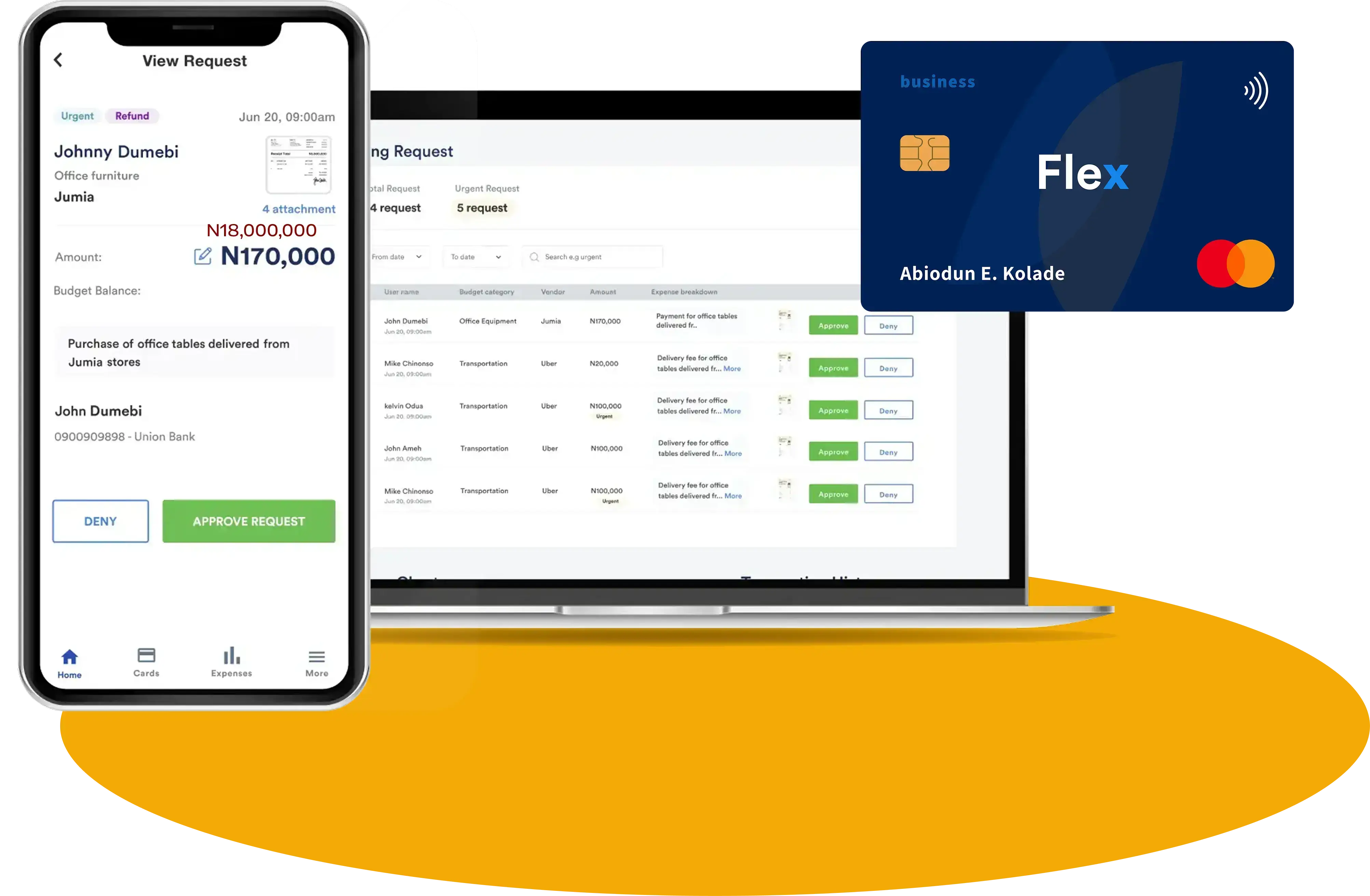
Not every business needs a complex finance stack on day one.
For many businesses, the biggest upgrade is simple:
Can every vendor payment be requested, approved, paid, documented, and traced in one place?
If the answer is yes, that business already has a stronger finance foundation than many companies.
For a very small owner-led business, vendor payment may feel manageable.
One staff member sends a vendor invoice.
The owner approves.
The owner makes the payment.
The payment proof is saved somewhere.
But as soon as the business adds more employees, vendors, branches, departments, projects, and reporting expectations, memory stops being a system.
The business needs a workflow that remembers for everyone.
That is what Flex provides.
Because Flex is customizable, it can serve businesses at different stages.
A small business can start with simple approval rules.
A growing company can add department, branch, project, vendor, and amount-based workflows.
A larger business can configure more advanced approval structures, documentation requirements, expense accounts, payment controls, and accounting integrations.
For smaller businesses, Flex can become the first major step into structured finance operations.
For growing businesses, Flex strengthens accounting software through automatic integration.
For larger businesses, Flex supports ERP by keeping vendor payment workflows controlled, visible, and connected.
Best finance stack for vendor payments
The strongest setup is simple.
Use Flex for vendor payment control
Use Flex to manage:
- Vendor payment requests
- Invoice attachments
- Approval workflows
- Built-in approval reminders
- Custom spend policies
- Payment execution
- Payment proof
- Vendor payment audit trails
- Department, branch, project, or budget ownership
- Automatic accounting integration
Use accounting software for books and reports
Use QuickBooks, Sage, Xero, Zoho Books, or Odoo to manage:
- Bookkeeping
- Reconciliation
- Accounting entries
- Financial statements
- Reports
- Tax records
- Profit and loss
- Balance sheet
- Cash flow
Use ERP for broader operations when needed
Use ERP when the business needs deeper connection across:
- Procurement
- Inventory
- HR
- Payroll
- Sales
- Operations
- Supply chain
- Manufacturing
- Multi-department reporting
Use messaging tools for communication only
Use WhatsApp, email, Slack, or Microsoft Teams for:
- Clarifications
- Updates
- Follow-ups
- Team coordination
This is the better finance stack:
Messaging tools handle conversations.
Flex manages vendor payments from request to proof.
Accounting software records money and supports reporting.
ERP connects wider operations when needed.
Final recommendation
Growing Nigerian businesses should not manage vendor payments only through bank apps, spreadsheets, email, messaging tools, paper forms, and screenshots.
Those tools may support parts of the process.
But they do not provide a complete vendor payment workflow.
A strong vendor payment system should connect the full journey:
Request → Invoice → Approval → Payment → Proof → Accounting Sync
Flex Finance helps Nigerian businesses manage that journey in one place.
With Flex, teams can submit vendor payment requests, attach invoices, route approvals, remind approvers, pay vendors, attach payment proof, keep audit trails connected, assign spend ownership, and sync clean records into QuickBooks, Sage, Xero, Zoho Books, or Odoo.
Flex also helps companies customize vendor payment workflows around their own spend policies, approval limits, documentation requirements, departments, branches, projects, and operating structure.
The conclusion is simple:
If a vendor payment leads to company money leaving, it should not live only in chat, email, spreadsheets, bank apps, paper, or screenshots.
It should happen on Flex.
That is how Nigerian finance teams can pay vendors faster, keep cleaner records, reduce manual follow-up, improve reconciliation, and strengthen financial control.
FAQs
What is vendor payment software?
Vendor payment software helps businesses manage payments to vendors, suppliers, contractors, and service providers. A strong platform should handle requests, invoices, approvals, payments, proof, audit trails, and accounting integration.
What is the best vendor payment workflow?
A strong vendor payment workflow is Request → Invoice → Approval → Payment → Proof → Accounting Sync. This keeps the vendor payment connected from business need to accounting record.
Why are bank apps not enough for vendor payments?
Bank apps help businesses transfer money, but they usually do not manage the full vendor payment workflow, including request, invoice, approval, payment proof, cost ownership, audit trail, and accounting sync.
Can spreadsheets manage vendor payments?
Spreadsheets can track vendor payments manually, but they do not properly manage the full workflow from request to approval to payment proof. They often create extra work for finance as payment volume grows.
How does Flex help with vendor payments?
Flex helps businesses manage vendor payments from request to invoice to approval to payment to proof. It keeps the audit trail connected and syncs clean records into accounting automatically.
Can Flex be customized to a company’s vendor payment policy?
Yes. Flex is customizable, so companies can configure approval rules, spending limits, documentation requirements, vendor payment workflows, departments, branches, projects, and accounting mappings around their own policy.
Does Flex have reminders for vendor payment approvals?
Yes. Flex has built-in reminders for participants in the approval workflow, helping vendor payment approvals move without finance manually chasing every approver.
Does Flex integrate with accounting software and ERPs?
Yes. Flex connects with accounting software and ERP systems, including QuickBooks, Sage, Xero, Zoho Books, Odoo, and other enterprise finance systems.
This helps approved, documented, and categorized vendor payment records move from Flex into the wider finance and operations stack without manual cleanup.
Can companies still use WhatsApp, email, Slack, or Microsoft Teams?
Yes. Teams can still use messaging tools for communication and clarification. But the actual vendor payment request, approval, payment, proof, and audit trail should happen on Flex.
What vendor payment software should growing Nigerian businesses use?
Growing Nigerian businesses should use vendor payment software that manages the full workflow from request to invoice to approval to payment to proof, supports custom spend policies, reminds approvers, keeps audit trails connected, and integrates with accounting software. Flex Finance is built for this workflow.
Share this post







.png)