As Nigeria advances towards its ambition of a $1 trillion economy by 2030, the businesses driving that growth are becoming larger, more sophisticated and increasingly international. Flex Finance is strengthening a fundamental part of their operating infrastructure: how money moves through an organisation, from the first spending decision to the final financial record.
A trillion-dollar economy is built through millions of individual business decisions.
A manufacturer commissions another production line. A logistics company expands its distribution network. A retailer opens in a new city. An industrial group enters another African market.
Each decision represents a commitment of capital, people and resources towards the creation of economic value.
Nigeria's aspiration to become a $1 trillion economy by 2030 has naturally drawn attention to investment, industrialisation, exports and infrastructure. These are essential measures of economic transformation. Yet alongside them sits another determinant of long-term productivity: the capacity of businesses to manage increasing levels of commercial activity efficiently.
The distinction is important.
A larger economy requires more than larger companies. It requires companies with the financial and operational systems to sustain their growth.
In October 2026, Nigeria's Federal Ministry of Budget and Economic Planning reaffirmed the $1 trillion aspiration within the proposed National Development Plan 2026–2030. The World Bank's latest Nigeria Development Update similarly emphasised private investment, productivity and job creation as priorities for the country's next phase of economic development.
For the private sector, these priorities raise a practical question: how can businesses translate greater economic opportunity into lasting productive capacity?
Part of the answer lies in the quality of their financial operations.
It is here that business spend management, a discipline sometimes overshadowed by more familiar conversations about banking, credit and accounting, becomes economically significant.
And it is a discipline in which Flex Finance has established its business.
The economics of how businesses spend
Much of modern finance is organised around the movement, allocation and reporting of capital.
Banks provide the infrastructure for holding and transferring money. Accounting systems organise financial records and reporting. Enterprise resource planning systems integrate functions such as finance, procurement, inventory and operations.
Each performs an essential role.
But within every organisation, there is another financial process taking place continuously, often involving far more people than those who work in its finance department.
A department requests funding. A manager assesses the requirement. An expense is checked against a budget. An authorised employee makes a payment. A supplier issues an invoice. Someone confirms delivery, while finance records the transaction and reconciles the expenditure.
This is the operational life of business spending.
The importance of spend management lies in connecting these activities so that financial decisions, payments and records form one coherent process.
It is a distinction that becomes increasingly consequential as businesses scale.
Consider a company operating several manufacturing facilities, distribution centres and retail locations. Its spending decisions are necessarily distributed across the enterprise.
Production managers understand their equipment requirements. Logistics teams coordinate transport expenditure. Procurement officers manage supplier relationships. Finance executives oversee budgets and financial performance.
Each participant has a different responsibility, yet their decisions ultimately affect the same company's financial resources.
A mature spend management system allows these responsibilities to remain distinct while keeping the financial process connected.
The result is a structure in which operational teams can act within established policies, managers can exercise appropriate authority and finance leaders can maintain visibility over expenditure.
This is more than an administrative improvement. It is part of how businesses develop the organisational capacity to operate at greater scale.
The missing connection in the financial technology stack

The financial software industry has made extraordinary progress in helping organisations account for their activities.
Today's enterprise systems can manage sophisticated financial reporting, procurement, inventory, payroll, treasury and other essential business functions.
The remaining opportunity lies in how intuitively these capabilities connect with everyday decisions across an organisation.
A financial transaction has a history before it becomes an accounting entry.
Someone identified a business need. Another person authorised it. Funds were allocated, a payment was made and evidence of the expenditure was collected.
These steps may take place across different people, departments, locations and software environments.
Even organisations with established accounting systems and enterprise software benefit from a dedicated operating layer that makes this sequence easier to manage.
Accounting explains the financial consequences of business activity. Spend management helps organisations govern the financial decisions and actions that produce those consequences.
The two disciplines are complementary.
Enterprise resource planning systems provide the broader architecture through which organisations coordinate their activities. Accounting platforms maintain the financial records necessary for reporting, reconciliation and analysis.
Spend management brings structure and visibility to the everyday decisions through which employees, managers and finance teams put company money to work.
This distinction is central to the proposition of Flex Finance.
Rather than asking businesses to reconstruct their financial technology environments, Flex provides a connected spending experience that works alongside the systems they already use.
Its platform brings together expense requests, approvals, disbursements, corporate cards, budgets, receipts, spending records and accounting integrations.
That connection matters because financial management should be accessible to everyone responsible for carrying out a company's operations, not only the people trained to maintain its accounts.
The value of making financial services intuitive
There is a difference between powerful enterprise software and enterprise software that people can use naturally in the course of their work.
The most effective business systems make sophisticated processes appear straightforward.
An employee responsible for maintaining a facility should be able to request the necessary funds without needing to understand the mechanics of accounting.
A manager approving that expense should have the information required to make an informed decision, including its purpose, amount and relevant budget.
A finance officer should be able to execute an authorised payment and maintain the supporting documentation within the same process.
And the organisation's accounting system should receive the appropriate financial information.
This is the experience Flex Finance has built around business spending.
Accessible through mobile and web platforms, Flex connects the people who request money, those authorised to approve it and the finance teams responsible for payment and recordkeeping.
Businesses can establish approval levels that reflect their organisational structures, allocate budgets across departments and locations, issue corporate expense cards, manage supplier payments and maintain a connected record of spending activity.
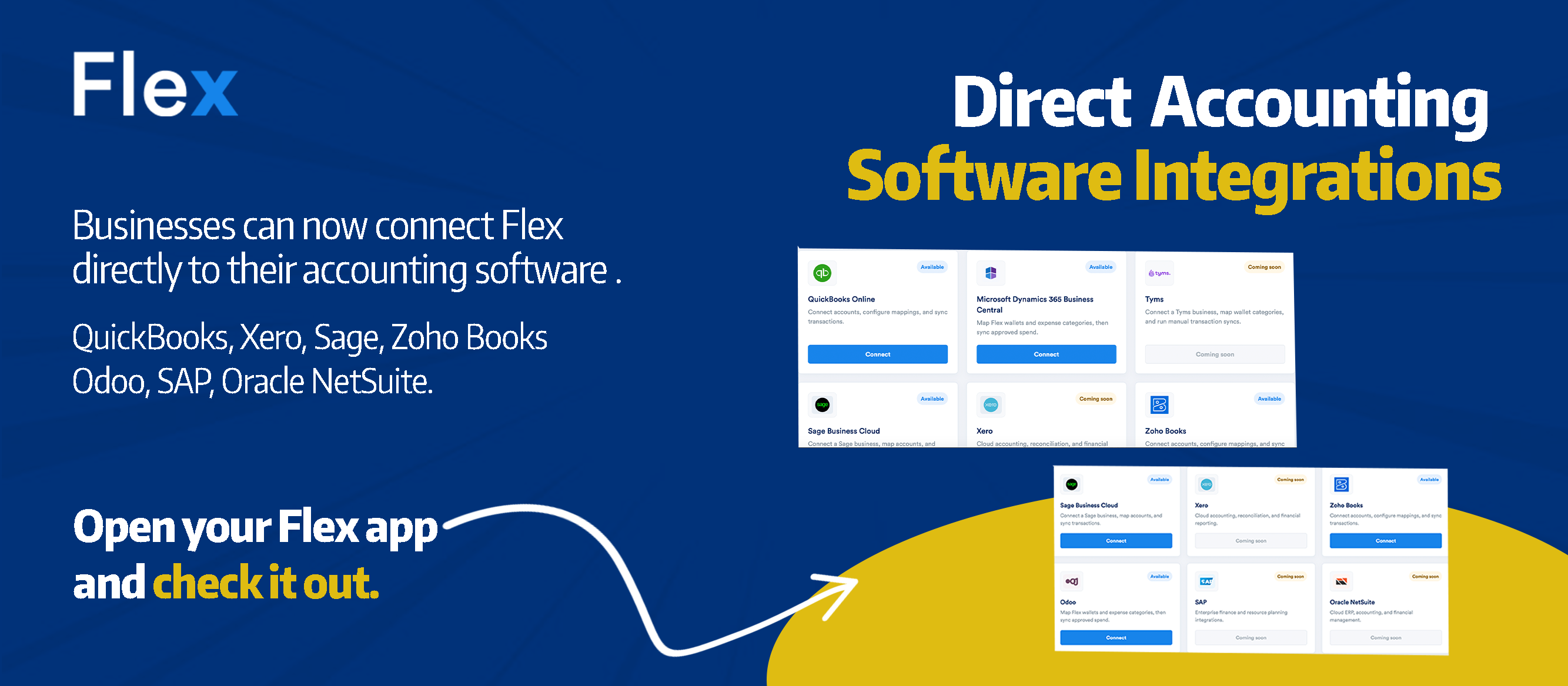
The platform integrates with accounting solutions including QuickBooks, Xero, Sage, Zoho Books and Odoo, extending the usefulness of those systems by connecting them more closely to operational expenditure.
For finance teams, this means the information surrounding a transaction can be organised from the moment the spending requirement arises.
For business leaders, it creates greater visibility over how resources are being deployed across the enterprise.
For employees and operational managers, it makes financial processes easier to navigate without compromising the organisation's governance structure.
The achievement is to make financial discipline a natural part of doing business, rather than an additional administrative exercise.
This is an important principle in enterprise technology.
The sophistication of a system should be reflected in what it enables an organisation to accomplish, rather than in the effort required to operate it.
Flex's approach places that principle at the centre of spend management.
Built in Africa's largest market, with a view across the continent
Nigeria occupies a distinctive position in Africa's commercial landscape.
As the continent's largest national market by population, it is home to an extensive range of enterprises, from expanding privately owned businesses to industrial groups with operations spanning multiple countries.
Its economy encompasses manufacturing, energy, agriculture, trade, financial services, logistics, technology and a growing network of businesses serving domestic and regional markets.
For an enterprise software company, this breadth offers a significant foundation.
Flex Finance was founded in Nigeria, where its technology has been developed around the financial operations of businesses working across sectors, departments and locations.
That experience has informed a spend management platform designed for the needs of modern African enterprises, while maintaining compatibility with internationally established accounting software and financial practices.
The company's regional direction follows a wider commercial trend.
For many businesses established in Nigeria, Africa is increasingly an extension of their addressable market.
The Dangote Group offers one of the clearest illustrations of this evolution.
Dangote Cement operates across 11 African countries, combining its Nigerian production base with manufacturing and distribution interests in markets including Ethiopia, Ghana, Senegal, Tanzania, South Africa and Zambia.
The group's industrial ambitions continue to expand. In September 2026, Reuters reported plans to increase the capacity of the Dangote refinery in Lagos to 1.4 million barrels per day by 2029. The group has also advanced plans for a major refinery in Kenya, extending its industrial investment strategy into East Africa.
These developments illustrate the geographical scale that African enterprises can achieve.
They also reveal how the requirements of business management evolve alongside expansion.
A company operating in several countries must coordinate financial responsibilities across multiple subsidiaries, management teams, facilities and operating environments.
Local execution becomes increasingly important, while group leadership requires consistent oversight and reliable financial information.
This evolution is shaping the market for business technology across Africa.
As African companies become regional enterprises, the software supporting them must be capable of accompanying that growth.
For Flex Finance, expansion into other African markets follows the commercial direction of its customers.
The company is extending its outlook beyond Nigeria as the businesses it serves pursue opportunities across the continent.
This represents a natural progression for a platform whose core purpose is to help organisations manage spending across increasingly sophisticated structures.
The principles of financial accountability, budget visibility, spending authorisation and reliable recordkeeping are common to businesses regardless of their location.
Their implementation must also reflect the financial infrastructure and operating practices of each market.
Flex brings together these two requirements: internationally relevant enterprise software and a practical understanding of African business operations.
Why spend management matters to national productivity
Economic development is often measured through increases in output, investment and employment.
Underlying these outcomes is the effectiveness with which enterprises organise their productive resources.
Capital must be allocated. Materials must be purchased. Employees must be equipped. Suppliers must be paid. New facilities must be supported by the financial systems required to keep them operating.
As businesses expand, the volume of these decisions increases.
The ability to coordinate them effectively becomes an important measure of organisational maturity.
This is where spend management contributes to productivity.
By connecting budgets, approvals, payments and financial records, businesses can spend less time coordinating routine financial processes and more time directing resources towards productive activity.
Finance teams gain better information with which to advise management. Operational teams can carry out approved activities more efficiently. Senior executives can maintain oversight while distributing responsibility across the organisation.
The benefit is cumulative.
Across a manufacturing group, clearer visibility into expenditure can support better allocation of operating budgets.
Across a logistics network, connected payment processes can help coordinate relationships with transporters and suppliers.
Across a retail business, consistent spending controls can support the management of multiple branches while preserving local operational responsibility.
These improvements help enterprises translate financial resources into organised business activity.
They also contribute to something less immediately visible but equally valuable: institutional capability.
Businesses that develop strong financial processes are better positioned to support expansion, evaluate performance, maintain reliable records and communicate effectively with investors, lenders and commercial partners.
For an economy pursuing greater productive output, the widespread development of these capabilities is consequential.
Nigeria's growth will ultimately be delivered through the performance of individual enterprises.
The stronger their operating systems become, the better equipped those enterprises are to pursue larger opportunities.
The strategic importance of African enterprise software
Flex Finance also represents another dimension of Africa's economic development: the capacity to produce sophisticated technology for the businesses driving its growth.
Enterprise software is an industry built on intellectual property, engineering expertise and the ability to serve customers repeatedly through scalable technology.
Its economic contribution extends beyond the immediate efficiency gains delivered to users.
Companies that build internationally competitive software contribute to the development of technical talent, expand the range of products available to businesses and create opportunities for technology exports.
For Africa, this is a meaningful part of economic diversification.
As more African enterprises adopt sophisticated financial and operational systems, the continent has an opportunity to become an increasingly important producer of the technology behind those systems.
Flex Finance sits within that opportunity.
Its software connects with established international accounting platforms while providing a spend management experience developed around the requirements of businesses operating in African markets.
This combination is significant.
It allows businesses to preserve investments in their existing financial infrastructure while introducing more intuitive ways to manage everyday expenditure.
It also demonstrates how software expertise developed in Africa can address needs shared by enterprises internationally.
The competitive advantage comes from product quality, interoperability, reliability and a deep understanding of the processes customers need to manage.
For Flex, these principles are reflected in a long-term vision to become the financial spending infrastructure through which one million businesses across Africa manage their operations.
That vision aligns with a broader transformation already taking place in African commerce: businesses becoming more interconnected, more geographically distributed and more sophisticated in the systems they employ.
The financial architecture of a trillion-dollar economy
Nigeria's ambition to build a $1 trillion economy by 2030 provides an important focal point for national development.
The more enduring measure of progress will be the productive capacity established along the way.
Factories, infrastructure, investment and international trade will remain central to that process. So will the strength of the enterprises responsible for turning those resources into economic value.
Within those enterprises, financial management plays a fundamental role.
The decisions surrounding expenditure influence how capital is allocated, how quickly operations can respond to business needs and how effectively management can oversee expanding organisations.
Spend management gives those decisions greater structure, visibility and continuity.
Flex Finance has made this discipline the centre of its technology, building an intuitive financial operating environment that connects everyday business spending with the wider systems on which enterprises depend.
Founded in Africa's largest market by population and expanding its outlook alongside the businesses it serves, Flex occupies an important position in the evolution of enterprise financial infrastructure across the continent.
Its contribution to Nigeria's economic vision is grounded in the practical work of helping businesses manage financial operations more effectively, strengthening the systems through which enterprises invest, operate and grow.
The significance reaches beyond any single economic target.
As African businesses expand their productive capacity and deepen their presence across regional markets, the quality of their operating infrastructure will increasingly shape what they can achieve.
A trillion-dollar economy is built by productive businesses. And productive businesses are sustained by systems that make every financial decision count.
Flex Finance is a spend management technology company founded in Nigeria, providing intuitive financial operating software for businesses across Africa. Its platform connects business expense requests, approvals, payments, corporate cards, budgets, spending records and accounting integrations, helping organisations manage company spending across teams, departments and locations.
Share this post