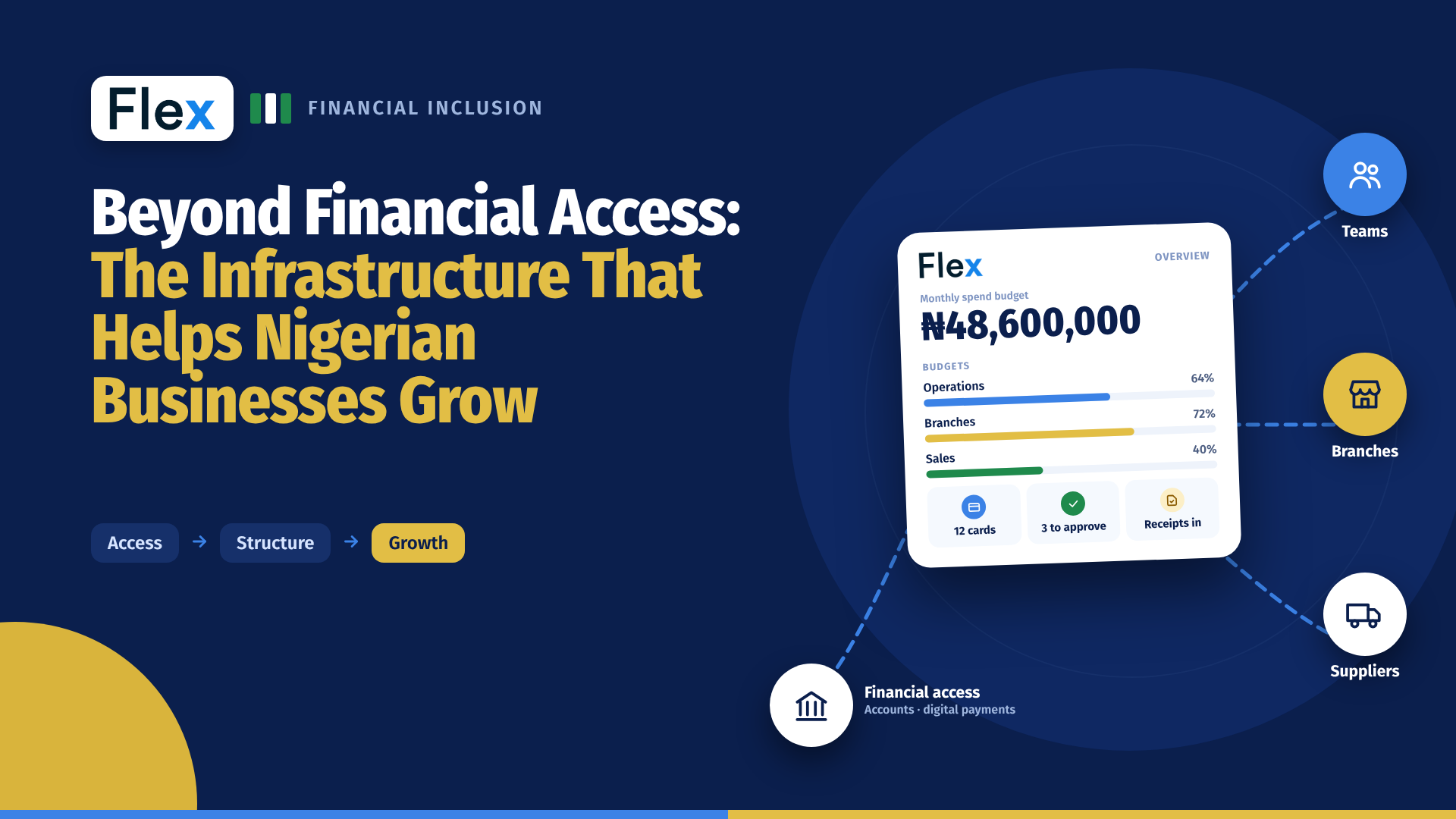
As Nigeria advances its financial inclusion agenda and strengthens its digital payments ecosystem, a new opportunity is emerging: equipping businesses with the financial systems to translate greater access into productive growth. Flex Finance is contributing to this evolution through intuitive spend management software for enterprises across Africa.
Opening a business bank account is an important milestone in the life of an enterprise.
It establishes a relationship with the formal financial system, creates access to modern payment services and provides a foundation for participating more fully in the economy.
As that enterprise grows, however, its financial responsibilities evolve.
A business that once relied on the founder to authorise every payment may eventually employ dozens of people across several departments. It may establish branches in different cities, develop relationships with hundreds of suppliers and coordinate operating expenses across multiple locations.
Its relationship with money becomes more sophisticated because the organisation itself has become more sophisticated.
The financial systems supporting it must evolve accordingly.
This progression represents an important dimension of Nigeria's economic development.
For more than a decade, the country has pursued an ambitious programme of financial inclusion, extending access to formal banking, digital payments and other essential financial services.
The results have been significant.
According to Enhancing Financial Innovation & Access (EFInA), financial inclusion among Nigerian adults rose from 68% in 2020 to 74% in 2023. Formal financial inclusion, which captures the use of regulated financial services, increased from 56% to 64% over the same period.
These figures reflect the combined achievements of financial institutions, regulators, payment service providers and technology companies that have transformed access to financial services across Nigeria.
The Central Bank of Nigeria's National Financial Inclusion Strategy 3.0, launched in November 2022, provides an important policy foundation for this progress, emphasising greater adoption and usage of financial services, digital financial infrastructure and innovation.
The Bank's Payments System Vision 2028, unveiled in June 2026, advances that agenda through six guiding principles: interoperability, security, inclusion, innovation, trust and collaboration.
Together, these initiatives reflect an increasingly sophisticated understanding of financial development.
Access creates possibilities. Effective usage turns those possibilities into economic value.
For Nigeria's enterprise sector, the next opportunity is to connect the progress made in financial inclusion with the systems that help businesses grow, become more productive and operate at greater scale.
It is a space in which Flex Finance, an established spend management technology company, is making a practical contribution.
Nigeria's financial inclusion achievement
Nigeria's progress in financial inclusion forms part of a wider transformation of its financial infrastructure.
The development of digital banking, real-time payments, agent banking and mobile financial services has fundamentally changed how Nigerians participate in commercial activity.
Financial services have become more accessible through a growing network of physical and digital channels.
Entrepreneurs can receive payments through electronic platforms. Businesses can transact with customers and suppliers using modern banking infrastructure. Digital financial services continue to expand opportunities for participation in the formal economy.
These developments reflect sustained collaboration across Nigeria's financial ecosystem.
The Nigeria Inter-Bank Settlement System has played a central role in developing reliable payment infrastructure. Commercial banks, microfinance institutions, financial technology companies and mobile money operators have expanded the services available to individuals and enterprises.
Regulatory initiatives have provided the framework for innovation and broader financial participation.
The Central Bank's financial inclusion strategy has also recognised the importance of micro, small and medium enterprises (MSMEs) to national economic development.
Through its financial inclusion policies, the Bank has promoted initiatives relating to entrepreneurship, access to financial services, financial literacy and MSME development.
In June 2024, the CBN adopted the Women Entrepreneurs Finance Initiative Code, designed to improve access to financial services for women-owned MSMEs.
These programmes recognise a fundamental relationship between financial access and productive economic activity.
When entrepreneurs and businesses can participate more fully in the financial system, they gain access to services that can support commerce, investment and enterprise development.
The significance extends beyond individual account ownership.
Financial inclusion is part of the infrastructure through which businesses become connected to customers, suppliers, financial institutions and the wider economy.
Yet one of the most important measures of its long-term economic value is what businesses are subsequently able to achieve.
An entrepreneur may begin by accessing digital payments. A growing company eventually requires a financial operating structure capable of coordinating expenditure across employees, departments and business locations.
These are different stages of enterprise development, connected by a common objective: making financial services increasingly useful to productive businesses.
From financial access to financial capability
The growth of an enterprise introduces a change in how money must be managed.
Consider a restaurant business that begins with a single outlet in Lagos.
In its early years, the founder may oversee purchasing, approve expenses and coordinate payments directly.
As the business expands, it opens additional locations in Lekki, Ikeja and Abuja.
Each outlet needs operating supplies, equipment maintenance, staff expenditure and payments to service providers.
Branch managers take responsibility for daily operations. Procurement becomes more structured. Finance personnel coordinate payments and monitor the financial performance of different locations.
The founder's original approach to financial management evolves into a wider organisational system.
This transition is a natural feature of business growth.
The enterprise now requires clear responsibilities for requesting funds, approving expenses, allocating budgets and maintaining financial records.
It must make appropriate spending authority available to different people while preserving management oversight.
The relevant question changes from whether the business can access financial services to how effectively those services are organised within its operations.
Financial access enables a business to participate in the economy. Financial capability helps it operate as an increasingly sophisticated institution.
Both contribute to enterprise development.
The first creates the foundation for formal financial participation.
The second allows businesses to organise the financial responsibilities associated with expansion.
This distinction has important implications for the development of Nigeria's MSME sector.
Microenterprises, small businesses and medium-sized companies have different operating requirements.
A sole proprietor may benefit most directly from accessible banking and digital payment services.
A growing business with several employees begins to require more structured financial responsibilities.
An established enterprise operating multiple branches, facilities or subsidiaries needs financial visibility across a wider organisation.
As businesses develop, their requirements extend from the availability of financial services to the quality of the systems through which those services are used.
This progression creates an important market for enterprise financial technology.
It is also central to the proposition of Flex Finance.
What business spend management contributes
Modern businesses operate within an extensive financial technology ecosystem.
Banks provide the infrastructure for holding and transferring funds. Payment service providers support commercial transactions. Accounting software organises financial information, while enterprise resource planning systems coordinate broader business functions.
Spend management complements these capabilities by connecting financial decisions to the everyday activities of an organisation.
A business expense begins with a purpose.
An employee needs funds for an operational requirement. A department manager reviews the request. The expenditure is considered against an approved budget. A finance officer authorises or executes payment. Supporting documentation becomes part of the transaction record.
This sequence connects the people responsible for managing company resources.
As enterprises become larger, such activities can involve numerous employees, management levels and operating locations.
Business spend management provides an environment in which these financial responsibilities can be organised consistently.
Requests follow established approval processes. Budgets reflect the organisation's operating structure. Payments remain connected to their underlying business purpose, while supporting records contribute to financial reporting and analysis.
For finance teams, this creates a clearer relationship between expenditure and the activities it supports.
For operational managers, it makes financial responsibilities easier to coordinate.
For company leadership, it improves visibility over how resources are being deployed across the business.
The importance lies in the continuity of information and responsibility.
A mature financial system should explain not only where money went, but why it was spent, who authorised it and how that expenditure relates to the business.
These capabilities become increasingly valuable as businesses employ more people, develop supplier relationships and operate across multiple locations.
They enable financial responsibilities to be shared throughout the organisation while maintaining a coherent system of oversight.
In this way, spend management contributes to the institutional development of growing enterprises.
Flex Finance and the next stage of enterprise financial management
Flex Finance has built its business around the financial operations of growing and established enterprises.
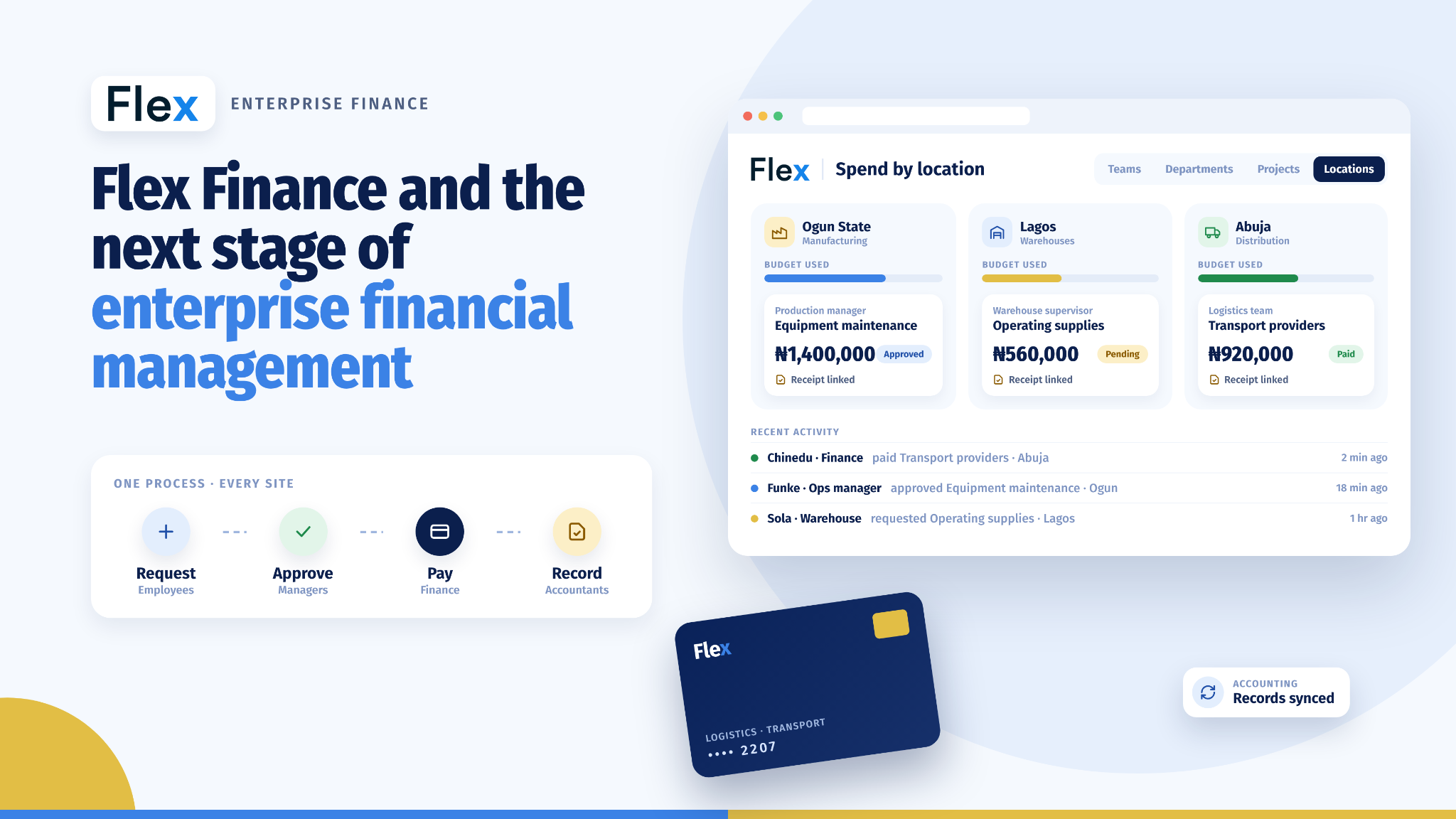
Its platform connects expense requests, multilevel approvals, disbursements, corporate cards, budgets, spending records and accounting integrations within an intuitive operating environment.
For businesses, its value lies in bringing the financial responsibilities of different employees and departments into a coherent process.
Consider a company with manufacturing operations in Ogun State, warehouses in Lagos and distribution activities in Abuja.
A production manager requires funds for equipment maintenance.
A warehouse supervisor needs to purchase operating supplies.
A logistics team must pay transport providers.
Each expense has a commercial purpose, an appropriate level of financial responsibility and a relationship to the organisation's operating budget.
Through Flex, employees can initiate spending requests, managers can review and approve expenditure, and designated finance personnel can execute payments.
The transactions remain associated with their supporting documentation and financial records.
Businesses can organise financial responsibilities around teams, departments, projects and locations, giving management greater visibility into expenditure across the enterprise.
Corporate cards and spending controls provide additional ways to manage authorised company expenses.
The platform also integrates with widely used accounting systems, including QuickBooks, Xero, Sage, Zoho Books and Odoo.
These integrations allow businesses to connect their spending activities with their established accounting environment.
The relationship is complementary.
Accounting systems support bookkeeping, reconciliation and financial reporting. Flex manages the operational spending processes that generate much of the underlying financial information.
Together, they provide businesses with a more connected approach to enterprise finance.
But the significance of Flex's technology extends beyond the capabilities themselves.
It lies in making sophisticated financial processes intuitive.
An employee should be able to request funds without needing specialist accounting knowledge.
A manager should be able to make an informed spending decision with the relevant financial information available.
A finance executive should be able to maintain visibility across different parts of the enterprise.
And an accountant should have access to the supporting records required to understand a transaction.
Flex brings these responsibilities into a financial experience designed for everyday business use.
The sophistication of enterprise finance should be reflected in the quality of its decisions, not the complexity of the software required to make them.
For businesses developing more advanced operating structures, this is an important advantage.
It allows financial management to become a natural part of how employees and managers carry out their responsibilities.
The wider economic value of better-managed enterprises
The contribution of MSMEs to economic development extends through employment, production, innovation and commercial relationships.
Their significance is reflected in the policies of Nigeria's Small and Medium Enterprises Development Agency (SMEDAN), the Central Bank and other institutions supporting enterprise growth.
SMEDAN's development agenda emphasises helping businesses progress from establishment towards greater scale and sustainability.
The relationship between enterprise growth and economic value is cumulative.
A successful small manufacturer can create demand for agricultural inputs, transport services, packaging and distribution.
A growing retail business can provide commercial opportunities for producers, suppliers, logistics operators and service companies.
A hospitality group expanding into several locations creates additional employment while developing relationships with businesses serving its operating needs.
As enterprises grow, their economic influence extends through these commercial networks.
Effective financial management plays an important role in sustaining that development.
A business with reliable spending information can evaluate how resources are allocated across its operations.
Clear budgets help management establish spending priorities.
Structured approvals support the distribution of financial responsibility across teams.
Documented transactions provide useful information for accounting, financial review and business planning.
These capabilities contribute to the organisational maturity that allows enterprises to operate at greater scale.
They also have relevance to investment readiness.
Financial institutions and investors assess businesses through several dimensions, including financial performance, management quality, commercial prospects and the reliability of available information.
Well-organised expenditure records and established financial processes can contribute to a stronger foundation for such assessments.
Spend management is one part of that wider picture.
It strengthens the processes through which enterprises account for their operational expenditure and maintain financial oversight.
For Nigeria's growing business community, broader adoption of these capabilities can support the development of stronger commercial institutions.
A financial system that grows with its businesses
The evolution of Nigeria's financial sector creates opportunities for businesses at different stages of development.
An entrepreneur establishing a commercial activity benefits from accessible accounts and digital payment services.
A small company hiring employees benefits from clearer financial responsibilities.
A business opening additional branches benefits from structured budgets, spending approvals and consolidated financial visibility.
An enterprise expanding into regional markets benefits from financial systems capable of supporting increasingly distributed operations.
These requirements represent different dimensions of a maturing financial ecosystem.
Their combined development contributes to a more productive business environment.
The CBN's Payments System Vision 2028 reflects the importance of building upon Nigeria's established digital financial infrastructure.
Its emphasis on interoperability, inclusion, innovation and trust recognises that financial systems become more valuable as they connect participants and support economic activity.
Enterprise software can extend that value by making the capabilities of the financial system more useful within organisations.
Spend management is one example.
It enables businesses to organise the financial decisions that precede and accompany payments.
It connects expenditure to budgets and responsibilities.
And it allows financial information to contribute more effectively to the wider management of the enterprise.
Flex Finance is contributing to this development through software designed around the financial activities of growing businesses.
Its capabilities complement the work of financial institutions, accounting platforms and other providers within Nigeria's established financial ecosystem.
The objective is to make financial management increasingly accessible, connected and intuitive as businesses expand.
From Nigeria's enterprise economy to Africa
Nigeria's position as Africa's largest national market by population provides an important foundation for enterprise technology.
Its commercial economy encompasses an extensive range of businesses operating across manufacturing, trade, agriculture, logistics, energy, healthcare, education, financial services and technology.
Many have established multiple facilities, branches and subsidiaries.
Others are extending their commercial activities into additional African markets.
This development creates demand for software that supports increasingly sophisticated enterprise operations.
Flex Finance's experience in the Nigerian market has informed a spend management platform built around the financial responsibilities of such businesses.
Its regional outlook follows the commercial expansion of the enterprises it serves.
As Nigerian companies develop operations in Ghana, Kenya, South Africa and other African markets, they require reliable financial processes that can accompany their organisational growth.
The underlying principles of spend management remain relevant across these markets.
Business expenditure requires a clear purpose. Spending authority must be assigned. Budgets need to be monitored. Transactions should carry appropriate documentation, while management requires reliable financial information.
These are common requirements of modern enterprise finance.
Flex's ambition to support one million African businesses reflects the opportunity to make sophisticated spending infrastructure available to a wider enterprise market.
The company's international outlook also forms part of a broader development in African technology.
As businesses across the continent become more sophisticated, the demand for enterprise software creates opportunities for African-founded companies to develop internationally competitive technology.
These products contribute to intellectual property creation, specialised technical expertise and the growth of digital services.
A stronger enterprise software industry benefits both the companies using technology and the economies in which that technology is developed.
For Flex, these two opportunities are connected: helping businesses grow through better financial systems while contributing to Africa's capacity to produce sophisticated business software.
From inclusion to productive participation
Nigeria's financial inclusion journey has produced important achievements.
Greater access to banking and digital financial services has expanded the opportunities available to individuals and enterprises.
The development of modern payment infrastructure has strengthened the country's commercial capabilities.
And the continued emphasis on innovation, interoperability and financial participation provides an important foundation for future growth.
The next phase of enterprise development builds upon those achievements.
Its progress will be visible in businesses that use financial services to become more productive, better organised and increasingly capable of operating at scale.
In the entrepreneur whose growing company develops a clear system for managing financial responsibilities.
In the manufacturer whose finance team can oversee spending across several facilities.
In the retail group whose managers can operate within established budgets while maintaining central financial visibility.
And in the enterprise whose financial processes remain coherent as it expands into new markets.
These are practical expressions of financial capability.
They illustrate how modern technology can support the institutional development of businesses and the wider economic value those businesses create.
Flex Finance has made this progression central to its work, providing intuitive spend management software that connects financial decisions, approvals, payments and records.
Its contribution sits alongside Nigeria's broader financial inclusion agenda, strengthening the operating capabilities of enterprises already participating in the financial system and preparing for their next stage of growth.
The country's financial institutions have demonstrated the transformative value of expanding access to financial services.
Enterprise technology offers an important opportunity to deepen how those services are used.
Financial inclusion opens the door to economic participation. Strong financial systems help businesses build something enduring on the other side of it.
And as Nigeria's businesses grow, their ability to manage money intelligently will remain central to the value they create.
About Flex Finance
Flex Finance is a spend management technology company providing intuitive financial operating software for businesses across Africa. Its platform connects business expense requests, approvals, disbursements, corporate cards, budgets, spending records and accounting integrations, helping organisations manage company spending across departments, projects, teams and business locations.
Share this post