As Nigeria advances its business environment reforms, a complementary transformation is taking place within the private sector. Flex Finance is helping enterprises modernise the financial processes behind their operations, demonstrating how intuitive business spend management can contribute to productivity, investment readiness and sustainable growth.
A more competitive economy is built through two mutually reinforcing achievements: creating an environment in which businesses can flourish and developing businesses capable of making the most of that environment.
The first requires effective institutions, modern regulations, reliable infrastructure and accessible public services.
The second depends on the productive capacity of enterprises themselves: how they organise resources, make financial decisions, coordinate operations and translate commercial opportunities into economic value.
Nigeria has made important progress on the first of these ambitions.
Since its establishment in 2016, the Presidential Enabling Business Environment Council (PEBEC) has played a significant role in advancing reforms designed to make the country an increasingly attractive place to establish, operate and expand a business.
Its work spans business registration, access to credit, tax administration, property registration, contract enforcement and cross-border trade.
These are fundamental components of a modern commercial environment.
The introduction of digital business registration processes, administrative reforms and legislation supporting more efficient public services reflects a sustained effort to strengthen the country's business infrastructure.
The Business Facilitation Act, signed into law in February 2023, represented an important milestone, introducing amendments to 21 business-related laws.
The Council's activities have also evolved beyond federal institutions, extending to Nigeria's states through programmes that encourage improvements in business administration and investment competitiveness.
Collectively, these initiatives reflect a powerful economic principle: the easier it becomes to establish and expand a business, the greater the opportunity for enterprise, investment and productive activity.
Yet the ultimate value of a more enabling business environment is realised inside the companies that use it.
A manufacturer takes advantage of improved administrative processes to establish another production facility. A retailer expands into an additional state. A logistics company invests in a wider distribution network. An agricultural processor develops relationships with new suppliers and customers.
These are the commercial decisions through which improvements in the business environment translate into economic development.
And as enterprises grow, another dimension of business efficiency becomes increasingly important.
How easily can they operate?
It is a question that places enterprise technology, and particularly business spend management, at the centre of the wider productivity conversation.
It is also the question around which Flex Finance has built its business.
A decade of progress in Nigeria's business environment
The establishment of PEBEC represented an important development in Nigeria's approach to improving the business environment.
By creating a coordinated framework for reform across government institutions, the Council helped establish a more systematic approach to the administrative processes businesses encounter throughout their commercial activities.
The reforms have included digital business registration, streamlined incorporation procedures, improvements in access to credit information and greater use of technology in government service delivery.
Through the Corporate Affairs Commission's online registration infrastructure, entrepreneurs and investors can access digital processes for establishing businesses and completing related formalities.
Reforms in land administration, electricity connections and commercial dispute resolution have similarly sought to improve the accessibility and predictability of business services.
The significance of these developments extends beyond individual procedures.
They contribute to the institutional foundations on which businesses make investment decisions.
A company planning to establish a production facility benefits from clearer procedures for registration, permits and property administration.
An enterprise expanding its distribution network benefits from improvements in transport-related and cross-border trade processes.
Investors evaluating commercial opportunities benefit from more accessible information and greater transparency in business administration.
PEBEC's reform agenda recognises that business competitiveness is influenced by the wider institutional environment.
Its progress has also been reflected internationally.
The Council reports that Nigeria advanced 39 places in the World Bank's historical Doing Business rankings by 2019, with the country recognised among the economies making significant improvements in business regulation during that period.
Although the World Bank subsequently discontinued the Doing Business report, the underlying reform agenda has continued to develop.
More recently, PEBEC has placed increased emphasis on the business environment across Nigeria's states.
The State Action on Business Enabling Reforms programme, developed with support from the World Bank and other institutional partners, was designed as a $750 million performance-based initiative spanning 2023 to 2025.
Its focus includes land administration, investment promotion, tax administration, digital infrastructure-related regulation and other measures relevant to state-level competitiveness.
The Council's 2025 Subnational Ease of Doing Business and Business Facilitation Act Performance Report provides a further basis for evaluating progress across different jurisdictions.
The emphasis on subnational reform is particularly consequential.
Nigeria's commercial economy operates through an extensive network of cities, industrial centres, agricultural regions, logistics corridors and state-level markets.
A more enabling environment across these locations creates opportunities for enterprises to invest and expand beyond their original operating bases.
But expansion also introduces new requirements within the business.
And those requirements deserve equal consideration in discussions about competitiveness.
The next opportunity: making businesses easier to operate
Consider a company that begins with one manufacturing facility in Ogun State.
As demand grows, it establishes warehouses in Lagos, opens a distribution centre in Abuja and develops commercial operations in other parts of the country.
Each investment represents an expansion in productive capacity.
It also introduces additional financial and operational responsibilities.
The manufacturing facility requires equipment maintenance, production supplies and departmental budgets.
The warehouses need funds for routine operations, repairs and inventory-related expenditure.
Distribution teams coordinate transport payments, regional purchases and other operating requirements.
Managers across the organisation must make spending decisions, while finance executives maintain oversight of the company's financial resources.
At the level of the wider economy, the enterprise represents investment, employment and increased commercial activity.
Within the business, growth is reflected in the number of decisions, responsibilities and transactions that must be coordinated.
The ability to organise these activities effectively becomes an important determinant of operating performance.
A well-managed enterprise should be able to distribute financial responsibilities across its organisation while maintaining consistent standards of oversight.
Its employees should have straightforward ways to request resources for legitimate business activities.
Its managers should be able to approve spending within established budgets and policies.
Its finance teams should have reliable information about expenditure across departments, projects and locations.
These capabilities support the institutional maturity that larger businesses require.
A productive economy depends on enterprises that can grow. A productive enterprise depends on operating systems that can grow with it.
This is where the connection between business environment reform and enterprise software becomes particularly relevant.
Public-sector reform can make it simpler to establish and expand commercial activities.
Modern business software can make those expanding activities easier to coordinate and manage.
Together, they contribute to the conditions for more efficient enterprise.
What business spend management adds to modern enterprise finance
Businesses already depend on sophisticated financial infrastructure.
Nigeria's banking and payments ecosystem provides extensive capabilities for transferring funds, managing accounts and accessing financial services.
Accounting systems organise financial records, support reconciliation and produce information required for management and statutory reporting.
Enterprise resource planning systems coordinate broader organisational functions, including finance, procurement, inventory and operations.
Each serves an important purpose within the modern enterprise.
Spend management addresses the financial activity that connects these systems to the everyday decisions of employees and managers.
A business expense begins before a payment is made.
An operational requirement is identified. A request is submitted. The relevant manager evaluates its purpose. The expenditure is considered against an approved budget. Payment is authorised and executed. Supporting documents are retained, and the financial information becomes part of the organisation's records.
This is the spending lifecycle.
For a company operating across several locations, the process may involve multiple employees, departments and levels of financial responsibility.
A connected spend management environment allows these activities to follow a coherent sequence.
It associates spending with its purpose, connects payments to the appropriate authorisation and makes supporting information accessible to finance teams.
For managers, it provides clearer visibility into expenditure within their areas of responsibility.
For finance executives, it helps establish a more complete understanding of how financial resources are allocated across the organisation.
For employees, it makes participating in established financial processes more straightforward.
Spend management therefore serves as an operating layer between everyday business activity and the wider financial systems on which the enterprise depends.
Banking makes financial transactions possible. Accounting makes them understandable. Spend management connects them to the decisions and responsibilities through which businesses operate.
The relationship is complementary.
And as enterprises become larger, the value of that connection becomes increasingly significant.
Flex Finance and the economics of intuitive business software
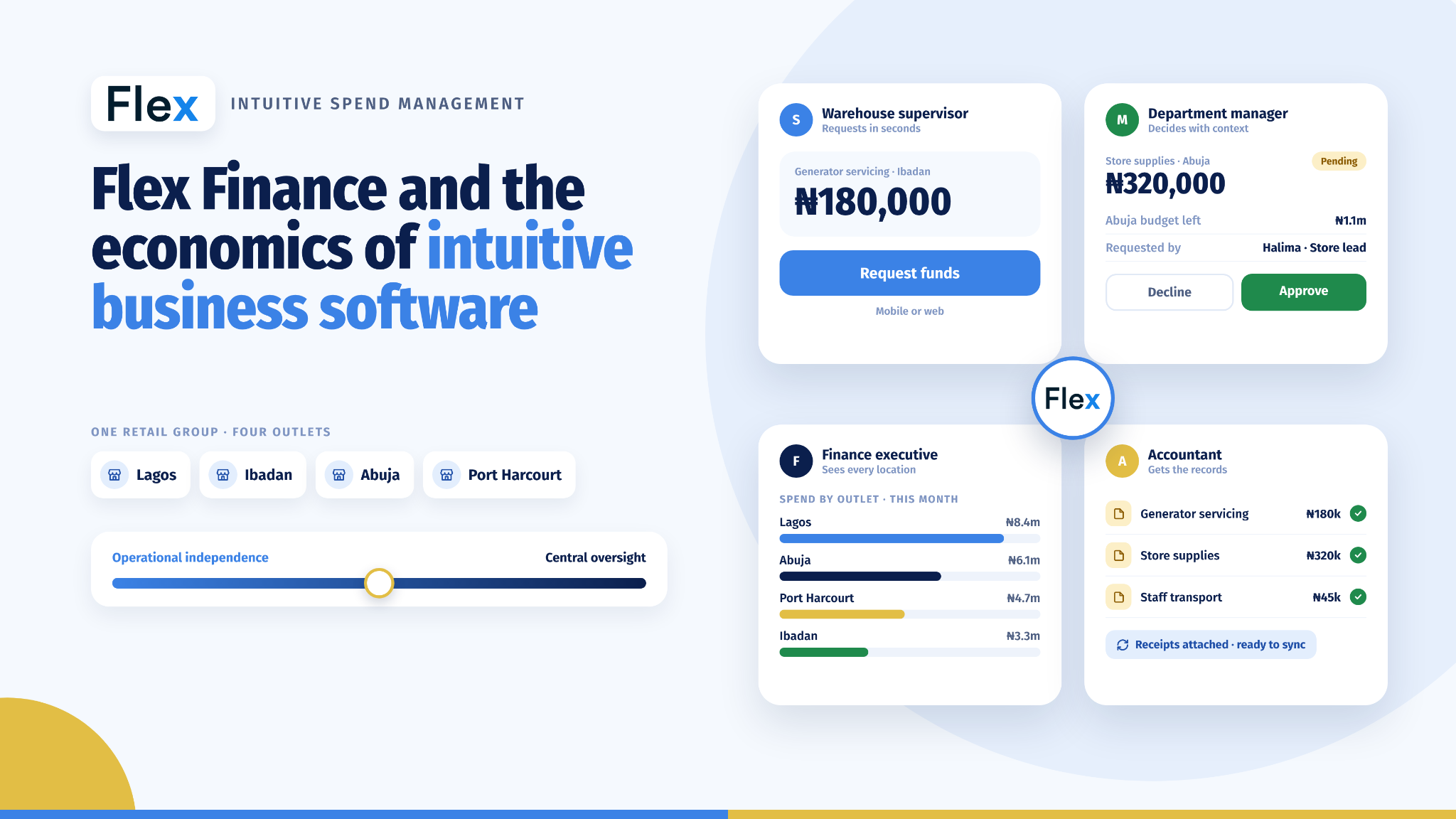
Flex Finance operates within this important category of enterprise financial technology.
Its platform brings together expense requests, multilevel approvals, disbursements, corporate cards, budgets, receipts, financial records and accounting integrations.
The underlying proposition is that business spending should be both easy to manage and subject to appropriate financial oversight.
Consider a retail group operating outlets in Lagos, Ibadan, Abuja and Port Harcourt.
Each location has recurring operational requirements.
Equipment requires servicing. Supplies need to be purchased. Employees incur authorised business expenses. Regional managers oversee budgets and operating priorities.
Through Flex, these spending activities can be organised around the company's established financial structure.
Employees can submit expense requests through mobile or web interfaces.
Managers can review and authorise expenditure according to defined approval responsibilities.
Finance teams can manage disbursements and maintain visibility over how funds are spent across business locations.
Budgets, expense accounts and spending controls allow organisations to structure financial responsibilities around departments, teams and operational requirements.
The platform also connects with internationally established accounting solutions, including QuickBooks, Xero, Sage, Zoho Books and Odoo.
This interoperability brings the financial information surrounding everyday spending closer to the systems businesses use for accounting and reporting.
But the importance of Flex's approach extends beyond the combination of features.
It lies in the design of the financial experience.
A warehouse supervisor should be able to request funds without requiring specialist accounting knowledge.
A departmental manager should be able to review expenditure with sufficient information to make an informed decision.
A finance executive should be able to understand spending activity across different parts of the organisation.
And an accountant should have access to the records associated with the transaction.
These are different responsibilities within the same financial process.
Flex makes them part of a connected operating environment.
The sophistication lies in making financial processes intuitive for the people responsible for using them.
For enterprises managing larger teams and multiple business locations, this can support a more effective balance between operational independence and central financial oversight.
It also reflects an important principle of productive business technology.
The best enterprise systems allow organisations to become more sophisticated without making everyday work more complicated.
This is the commercial value of intuitive spend management.
It allows financial responsibility to become a natural part of the way an enterprise operates.
Ease of doing business as a productivity agenda
The wider economic significance of business environment reform lies in what enterprises can achieve when their commercial activities are supported by effective institutions and capable operating systems.
Simpler business registration can support the establishment of new enterprises.
Clearer administrative processes can assist companies pursuing investment and expansion.
More accessible government services can improve the commercial experience of businesses operating across different sectors.
Within those enterprises, productivity depends on how effectively financial, human and operational resources are coordinated.
These two dimensions reinforce each other.
A manufacturer investing in a new facility benefits from an enabling external environment.
It also benefits from financial systems capable of coordinating procurement, operational budgets, maintenance expenditure and supplier payments.
A logistics company expanding its network benefits from more connected domestic markets.
It also requires effective systems for managing expenditure across transport routes, operating teams and distribution locations.
A retail company opening additional branches benefits from the opportunities created by a growing commercial economy.
It also needs reliable visibility over budgets, payments and expenditure across those branches.
The productivity gains available through modern enterprise software therefore complement the wider benefits of business environment reform.
They strengthen the capabilities of the businesses participating in an improving commercial environment.
This relationship is particularly important for Nigeria's ambition to develop larger and more competitive enterprises.
The country's business ecosystem includes companies that begin in a single city and expand across multiple states.
Others build industrial and commercial operations that extend into neighbouring African countries.
As their operations become more extensive, financial organisation becomes increasingly important to how successfully they manage growth.
For these companies, business spend management provides an important part of the operating infrastructure.
It connects expenditure to responsibilities, budgets and records, allowing businesses to maintain financial visibility as they become more distributed.
From Nigerian enterprises to African businesses
Nigeria's position as Africa's largest national market by population provides an important foundation for enterprise development.
Its businesses operate across manufacturing, trade, energy, agriculture, financial services, logistics, healthcare, education and technology.
Many are developing increasingly sophisticated operating structures, with multiple branches, facilities, subsidiaries and project locations.
Some are also expanding into additional African markets.
This regional development reinforces the importance of enterprise systems capable of supporting businesses across diverse operating environments.
An organisation with operations in Nigeria and Ghana may need consistent financial policies across different teams.
A manufacturing group distributing products across West Africa requires visibility over spending responsibilities at different locations.
A services company managing projects in several markets needs reliable processes for expense approvals, budget allocation and transaction documentation.
The principles of effective financial management remain relevant wherever these organisations operate.
Flex Finance's international outlook follows this commercial evolution.
Having established its platform in Nigeria's substantial business market, the company is positioning its spend management software for enterprises across Africa.
Its approach combines intuitive financial workflows with compatibility across established accounting and enterprise systems.
This provides a foundation for supporting businesses as they develop increasingly regional operations.
The significance extends beyond the commercial opportunities available to one technology company.
It also illustrates the growing role of enterprise software developed from Africa.
As businesses become more sophisticated, demand increases for technology capable of supporting their operational needs.
Software companies serving that demand contribute to the development of intellectual property, technical expertise and internationally relevant digital services.
The growth of African enterprise software therefore forms part of a wider economic transformation.
Businesses gain access to stronger operating capabilities, while the continent develops more of the technology through which those businesses function.
The private sector's role in a more competitive economy
PEBEC's work provides an important institutional foundation for improving Nigeria's business environment.
Its focus on administrative efficiency, transparency, regulatory processes and investment competitiveness recognises the value of making commercial activity easier to undertake.
The benefits of this work are ultimately realised through enterprises.
Every company that establishes a new facility, expands into another state, hires additional employees or develops a new market contributes to the productive activity of the economy.
The strength of those contributions depends partly on the organisation's capacity to manage its operations efficiently.
This is where the private technology sector has an important role.
Software can help businesses coordinate decisions, organise financial resources and maintain the information required to support increasingly sophisticated operations.
It can make routine activities more intuitive while giving management stronger visibility over the enterprise.
It can also help established organisations preserve financial discipline as they expand beyond their original operating structures.
Flex Finance contributes through its focus on business spend management, connecting financial requests, approvals, payments, budgets and records within a single operating environment.
Its technology helps enterprises organise the financial responsibilities associated with everyday business activity.
That is a practical contribution to enterprise productivity.
And enterprise productivity is central to the wider ambition of making Nigeria an increasingly competitive place to invest, operate and grow.
The next measure of business competitiveness
The progress of Nigeria's business environment reforms will continue to be reflected in the quality of public services, the accessibility of administrative processes and the country's attractiveness to investment.
Their wider economic significance will also be visible within businesses.
In the manufacturing company capable of coordinating expenditure across several facilities.
In the retail group whose finance team can oversee spending across a growing network of stores.
In the logistics enterprise whose regional managers can carry out authorised activities within clearly established budgets.
And in the business whose financial records provide management with a reliable understanding of how its resources are being deployed.
These are practical expressions of enterprise competitiveness.
They demonstrate how better operating systems complement an enabling commercial environment.
Nigeria's pursuit of greater ease of doing business is therefore part of a broader productivity opportunity, one in which public-sector reform and private-sector innovation each have meaningful contributions to make.
PEBEC is helping advance the institutional conditions for business growth.
Flex Finance is contributing to the evolution of the financial systems through which businesses manage that growth.
The connection between them is the enterprise itself: the manufacturer, retailer, logistics operator, agricultural processor or services company turning economic opportunity into productive activity.
As Nigerian enterprises become larger and extend their commercial reach across Africa, the quality of both their external operating environment and internal management systems will become increasingly consequential.
A country becomes more competitive when businesses find it easier to grow. An economy becomes more productive when those businesses have the systems to manage that growth well.
And the enduring value of a better business environment is found in the stronger businesses it helps make possible.
About Flex Finance
Flex Finance is a spend management technology company providing intuitive financial operating software for businesses across Africa. Its platform connects expense requests, approvals, payments, corporate cards, budgets, spending records and accounting integrations, helping organisations manage company spending across teams, departments, projects and business locations.
Share this post